
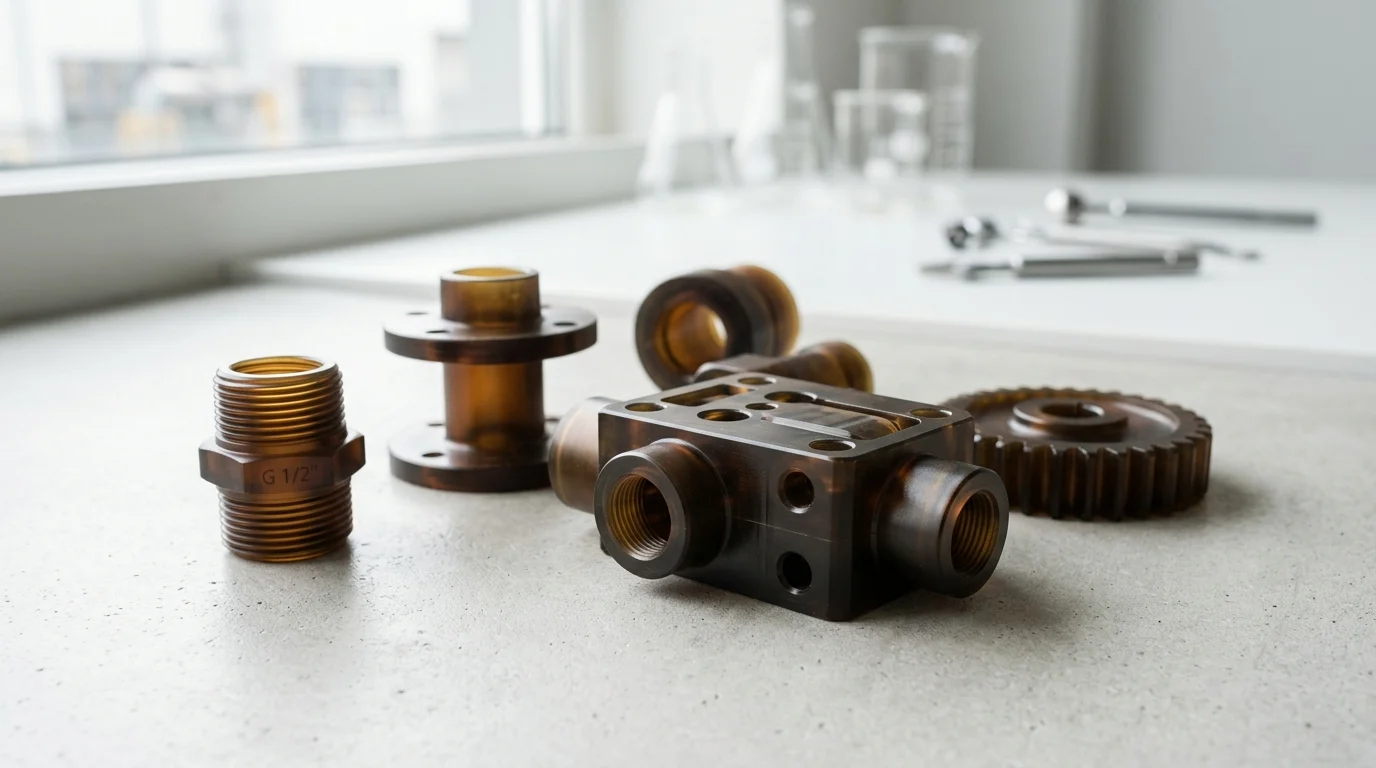
Brass has long been the default choice for potable water fittings, valves, and manifolds, but today’s plumbing networks face pressures that metal was not originally designed to absorb. Volatile copper pricing, stricter lead-content rules, and increasingly aggressive water chemistry are changing how engineers evaluate material performance over a system’s full service life. High-Performance PPSU is gaining ground because it combines thermal stability, mechanical toughness, and chemical inertness in applications where corrosion resistance and installation efficiency matter. This article examines why PPSU is becoming a practical alternative to brass, where replacement delivers the clearest value, and what designers should consider when specifying components for modern water distribution systems.
Why PPSU Is Emerging as an Alternative to Brass
For decades, potable water networks relied heavily on metallic components, with brass serving as the undisputed industry standard for fittings, valves, and manifolds. Today, however, the plumbing and engineering sectors are undergoing a significant material transition. High-Performance PPSU (Polyphenylsulfone) has evolved from a specialized aerospace and medical plastic into a mainstream, high-volume material for global water infrastructure.
This shift is not merely a trend toward plastics, but a calculated engineering response to the limitations of traditional metallurgy. As water quality parameters change and environmental regulations tighten, system designers must re-evaluate the long-term viability of metal components. High-Performance PPSU offers a compelling combination of thermal stability, mechanical toughness, and absolute chemical inertness, specifically addressing the vulnerabilities of traditional brass networks.
Market pressures driving material change
The transition toward engineered polymers is accelerated by shifting global economics and strict environmental mandates. Raw material volatility in the metals market makes long-term project forecasting difficult; copper prices frequently fluctuate—recently sustaining levels above $8,500 per metric ton—directly impacting the cost of brass alloys. Concurrently, legislative changes have forced a redesign of brass formulations.
Regulations such as the U.S. Reduction of Lead in Drinking Water Act mandate that wetted surfaces of plumbing products contain no more than a weighted average of 0.25% lead. To achieve this, manufacturers have shifted to complex, bismuth- or silicon-based “lead-free” brass alloys. These alternative alloys are notoriously difficult to machine, suffer from higher defect rates, and often carry a 15% to 30% cost premium over traditional leaded brass, eroding the historical economic advantage of metal fittings.
Where metal replacement makes sense
Metal replacement is most advantageous in systems where water chemistry poses a corrosion risk or where installation efficiency is paramount. High-Performance PPSU is increasingly specified for cross-linked polyethylene (PEX) piping systems, manifold assemblies, and multi-layer composite pipe (MLCP) networks in both residential and commercial applications.
These systems typically operate at standard municipal pressures, requiring components to reliably handle continuous operating pressures up to 10 bar (145 psi) at elevated temperatures. In aggressive water environments—characterized by high chloride content, low pH, or soft water conditions—brass components remain highly susceptible to dezincification and stress corrosion cracking. By replacing metal with PPSU at these specific nodes, engineers eliminate the risk of galvanic corrosion and extend the reliable service life of the entire plumbing network.
What PPSU Means for Potable Water Systems

Integrating High-Performance PPSU into water distribution networks requires an understanding of its unique polymer architecture. As an amorphous, high-temperature sulfone polymer, PPSU lacks the crystalline structure found in standard commodity plastics. This molecular configuration provides exceptional dimensional stability and resistance to sudden impact that is crucial for components subjected to water hammer and pressure spikes.
Key material properties
The mechanical and thermal properties of High-Performance PPSU place it at the apex of engineering thermoplastics. It boasts an extraordinarily high heat deflection temperature (HDT) of approximately 207°C (405°F), allowing it to withstand extreme thermal shocks without warping or losing structural integrity. Furthermore, it exhibits a Notched Izod impact strength of roughly 690 J/m, making it virtually unbreakable under standard installation conditions.
| Property | Typical Value | Unit | Standard Test |
|---|---|---|---|
| Density | 1.29 | g/cm³ | ASTM D792 |
| Tensile Strength (Yield) | 70.3 | MPa | ASTM D638 |
| Heat Deflection Temp (at 1.8 MPa) | 207 | °C | ASTM D648 |
| Notched Izod Impact | 690 | J/m | ASTM D256 |
| Water Absorption (24 hrs) | 0.37 | % | ASTM D570 |
This combination of high tensile strength and impact resistance ensures that PPSU fittings will not fracture when dropped on concrete job sites or when subjected to the aggressive expansion tools used in modern PEX installations.
Potable water performance requirements
Potable water applications present a uniquely harsh chemical environment due to the continuous presence of oxidizing disinfectants like chlorine and chloramines. While polyacetals (POM) and certain nylons degrade rapidly in hot, chlorinated water, High-Performance PPSU is highly resistant to oxidative degradation.
Extensive lifecycle testing demonstrates that PPSU fittings can withstand continuous exposure to 90°C (194°F) hot water at operational pressures for well over 50 years without a significant loss of tensile strength. Furthermore, the material’s exceptionally smooth internal surface finish prevents the buildup of scale and biofilm, maintaining optimal hydraulic flow rates and ensuring that water quality remains uncompromised from the municipal source to the end-user’s tap.
PPSU vs Brass: Performance Comparison
When engineering a commercial or residential water system, comparing High-Performance PPSU directly against traditional Dezincification Resistant (DZR) brass reveals distinct operational differences. While both materials are certified for potable applications, their physical characteristics dictate different approaches to system design, installation, and long-term maintenance.
Strength, weight, and corrosion resistance
The most immediate physical difference between the two materials is weight. Standard DZR brass has a density of approximately 8.4 g/cm³, whereas PPSU has a density of just 1.29 g/cm³. This means PPSU fittings are roughly 85% lighter than their exact brass equivalents, drastically reducing shipping costs and installer fatigue on large-scale projects.
In terms of corrosion resistance, the comparison heavily favors the polymer. Even high-grade DZR brass can eventually succumb to dezincification—a process where zinc leaches out of the alloy, leaving a porous, brittle copper shell. PPSU, being a non-metallic polymer, is completely immune to galvanic corrosion, dezincification, and pitting, regardless of the local water chemistry.
Lead-free and safety considerations
Safety and regulatory compliance represent another critical divergence. “Lead-free” brass is somewhat of an industry misnomer; under current standards, these alloys are still legally permitted to contain up to 0.25% lead by weight on wetted surfaces. Over time, particularly in stagnant or highly acidic water, trace amounts of heavy metals can still leach into the drinking supply.
High-Performance PPSU is an inherently pure material containing 0.0% lead. It is manufactured without the use of heavy metal stabilizers or toxic plasticizers. This absolute zero-lead profile provides municipalities and building owners with an unparalleled level of safety and entirely removes the risk of failing future, more stringent heavy-metal leaching tests.
Key trade-offs to evaluate
Despite its advantages, replacing brass with PPSU requires navigating specific engineering trade-offs. Brass remains superior in absolute tensile strength and rigidity, with yield strengths often exceeding 300 MPa, compared to PPSU’s ~70 MPa. Consequently, brass is still preferred for heavy-duty valves, large-diameter threaded transitions, and components that must bear significant mechanical loads or building weight.
| Parameter | High-Performance PPSU | DZR Brass (Lead-Free) |
|---|---|---|
| Galvanic Corrosion Risk | Zero | Moderate to High |
| Lead Content | 0.0% | Up to 0.25% |
| Weight (Density) | 1.29 g/cm³ | ~8.4 g/cm³ |
| Tensile Strength | ~70 MPa | >300 MPa |
| UV Resistance | Poor (Requires shielding) | Excellent |
Additionally, PPSU is vulnerable to prolonged ultraviolet (UV) exposure. If PPSU fittings are installed outdoors or in environments with intense, direct sunlight, the polymer will undergo photo-oxidation, leading to discoloration and eventual embrittlement. Therefore, PPSU is strictly recommended for concealed, indoor, or underground applications unless specifically shielded.
How to Specify PPSU Fittings
Specifying High-Performance PPSU components requires rigorous attention to industry standards and manufacturing protocols. Because the plumbing market contains various grades of plastics, engineers must clearly define the compliance, installation, and quality assurance metrics required to ensure the deployment of genuine, high-grade sulfone polymers.
Compliance and certification checks
To guarantee suitability for human consumption, PPSU fittings must be verified against stringent global health standards. In North America, specifications must mandate compliance with NSF/ANSI 61 (Drinking Water System Components – Health Effects) and NSF/ANSI 372 (Drinking Water System Components – Lead Content).
For physical performance, the fittings should meet or exceed standards such as ASTM F2159 (for PEX systems) or ISO 15875 (Plastics piping systems for hot and cold water installations). In European markets, equivalent certifications like WRAS (UK), DVGW (Germany), or ACS (France) are critical benchmarks that validate both the purity of the raw resin and the structural integrity of the final molded part.
Installation and handling requirements
Proper specification must also account for the intended connection methodology. High-Performance PPSU is engineered to be highly compatible with modern cold-expansion connections (e.g., ASTM F1960) and traditional copper crimp ring systems (ASTM F1807).
Because of the material’s high impact strength, these fittings can be reliably installed in freezing conditions. Cold-expansion installations can typically be performed at temperatures down to -15°C (5°F) without the polymer cracking or failing. However, specification documents must strictly prohibit the use of certain chemical thread sealants, liquid pipe dopes, or anaerobic adhesives, as these can induce environmental stress cracking (ESC) in sulfone polymers; standard PTFE tape is the only recommended thread sealant.
Supplier qualification and traceability
The performance of a PPSU fitting is entirely dependent on the quality of the injection molding process. Specifiers should require suppliers to demonstrate strict lot traceability and maintain ISO 9001 certified quality management systems. High-tier manufacturers should operate with defect rates well below 500 Parts Per Million (PPM).
During the molding process, the raw PPSU resin must be thoroughly dried; moisture content must be maintained below 0.05% before injection. Failure to control moisture leads to hydrolytic degradation during molding, which drastically reduces the impact strength of the finished fitting. Specification documents should require suppliers to provide certificates of analysis (CoA) proving resin purity and proper processing controls.
When to Choose PPSU Over Brass
The decision to transition from brass to High-Performance PPSU should be based on a holistic evaluation of the project’s specific environmental conditions, scale, and long-term financial objectives. While brass will continue to hold a place in structural and transition applications, PPSU has established itself as the superior choice for the vast majority of standard distribution network connections.
Best-fit application scenarios
High-Performance PPSU is the optimal choice for multi-family residential complexes, hospitals, and hospitality venues where water quality cannot be compromised. It is particularly critical in geographic regions known for aggressive, soft, or highly chlorinated water, where traditional brass fittings frequently fail prematurely due to corrosion.
Furthermore, in high-volume construction projects, the ergonomic benefits become highly tangible. A commercial high-rise project may require the installation of over 10,000 individual fittings. The 85% weight reduction provided by PPSU significantly reduces installer fatigue, accelerates installation timelines, and minimizes the risk of repetitive strain injuries among plumbing contractors.
Decision factors for project teams
For project managers and procurement teams, the Total Cost of Ownership (TCO) heavily favors High-Performance PPSU. While the raw PPSU resin is a premium engineering plastic—often costing between $15 and $20 per kilogram—the manufacturing economics are highly efficient.
Injection molding allows for rapid, high-volume production with multi-cavity molds and virtually zero material waste, as sprues and runners can be reground and reused within strict specification limits. Consequently, finished PPSU fittings are typically 20% to 30% cheaper to procure than their lead-free brass counterparts. When combining this reduced unit cost with lower shipping weights, faster installation, and the elimination of corrosion-related warranty claims, PPSU presents a financially and technically superior solution for modern potable water networks.
Key Takeaways
- Specify PPSU for potable water nodes exposed to high chloride, low pH, or soft water to reduce dezincification and stress corrosion risks.
- Use PPSU fittings in PEX, MLCP, and manifold systems where components must handle up to 10 bar, or 145 psi, under elevated-temperature conditions.
- Factor metal price volatility into project planning, as copper prices above $8,500 per metric ton can undermine the cost predictability of brass components.
- Account for the 15% to 30% cost premium and higher machining difficulty of lead-free brass when comparing brass against engineered polymer alternatives.
- Choose chemically inert PPSU components to eliminate galvanic corrosion concerns at critical connection points in modern potable water networks.
Frequently Asked Questions
What is High-Performance PPSU?
High-Performance PPSU is an amorphous sulfone engineering polymer used for demanding plumbing components. It offers high thermal stability, impact resistance, dimensional stability, and chemical inertness for potable water applications.
Why are engineers replacing brass with PPSU in water networks?
PPSU helps avoid dezincification, stress corrosion cracking, and galvanic corrosion in aggressive water conditions. It also reduces exposure to volatile copper prices and the machining challenges of lead-free brass alloys.
Is PPSU suitable for hot and pressurized potable water systems?
Yes. PPSU is specified for systems that require reliable performance at standard municipal pressures, including continuous operating pressures up to 10 bar, or 145 psi, at elevated temperatures.
Where does PPSU replacement make the most sense?
PPSU is especially useful in PEX piping systems, manifold assemblies, and multi-layer composite pipe networks where corrosion resistance, installation efficiency, and long-term reliability are priorities.
How do lead-free regulations affect brass fittings?
Rules such as the U.S. Reduction of Lead in Drinking Water Act limit wetted surfaces to a 0.25% weighted average lead content. This has driven use of bismuth- or silicon-based brass, which can cost 15% to 30% more.
Post time: Jun-28-2026