
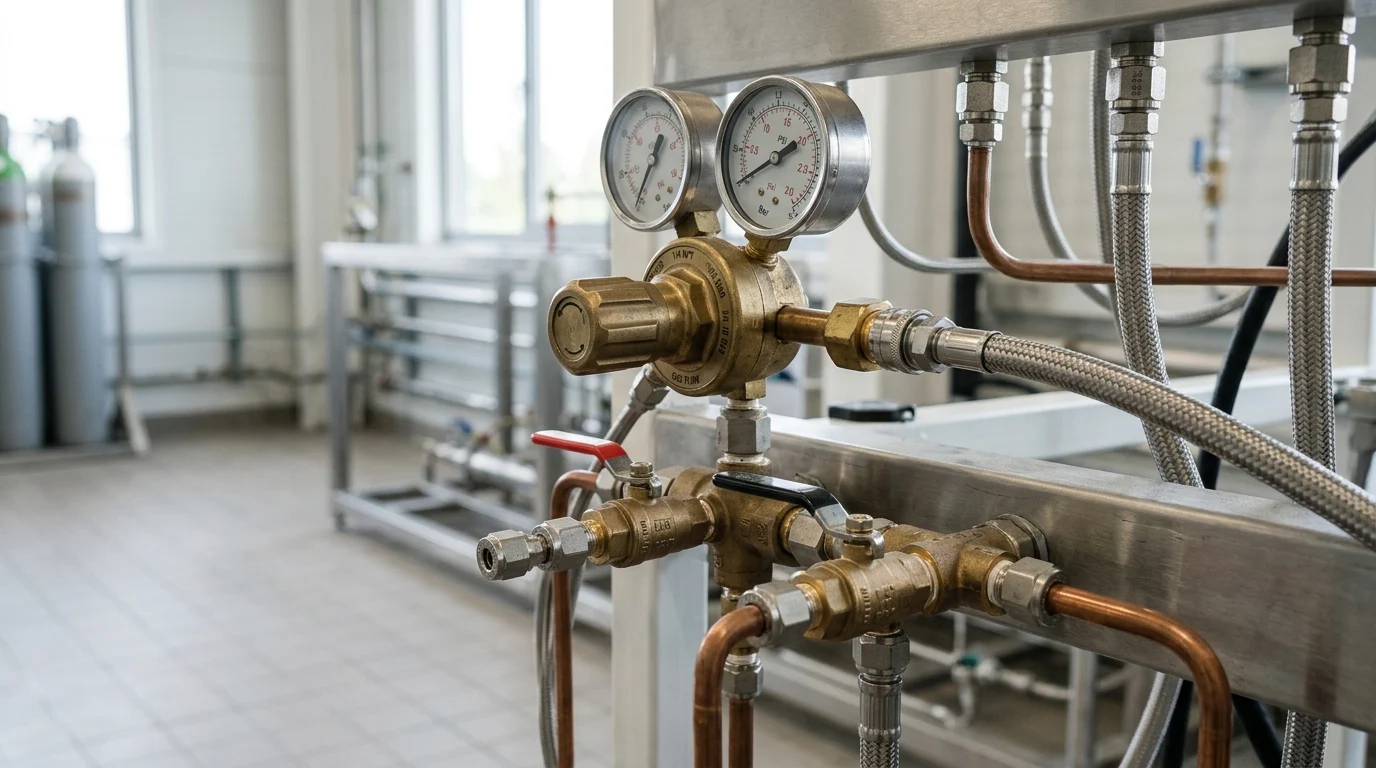
In high-purity gas delivery, a fitting is never just a small metal connector—it is a potential pass-or-fail point for safety, yield, and uptime. Semiconductor fabs, aerospace systems, and medical gas applications may require helium leak performance as low as 1.0 × 10⁻⁹ atm cc/sec, leaving no room for burrs, micro-scratches, thread galling, or uncontrolled tolerances. This article looks behind the scenes at the CNC machining discipline required to produce reliable critical gas fittings, from 316L VIM/VAR material selection and Class 3A/3B threading to sub-micron surface finishes, cleanliness controls, and inspection practices that help prevent costly failures before they reach the line.
How Zero-Defect Critical Gas Fittings Protect Safety and Uptime
In applications ranging from semiconductor wafer fabrication to aerospace propulsion and medical life support, the integrity of fluid and gas delivery systems is paramount. Critical gas fittings serve as the primary junctions in these systems, where even microscopic imperfections can lead to catastrophic outcomes. The CNC machining processes behind these components must operate under a zero-defect paradigm, as the margin for error is effectively nonexistent.
Why Zero Defects Matter in Critical Gas Systems
High-purity gas delivery systems often transport volatile, toxic, or highly reactive media such as silane, ammonia, or high-pressure hydrogen. In these environments, a zero-defect standard is not merely a quality target; it is a fundamental safety and operational requirement. A single compromised fitting can result in system-wide contamination, explosive hazards, or the loss of millions of dollars in semiconductor yields. Industry benchmarks for ultra-high-purity (UHP) gas systems typically mandate outboard helium leak rates not exceeding 1.0 × 10⁻⁹ atm cc/sec. Achieving this threshold requires flawless metal-to-metal seals, which are entirely dependent on the precision of the underlying CNC machining process.
Common Failure Modes in CNC-Machined Gas Fittings
When critical gas fittings fail, the root causes frequently trace back to subtle machining deviations rather than catastrophic material failure. Common failure modes include the galling of threaded connections—which prevents adequate torque and compromises the seal—and micro-scratches on sealing faces (such as VCR glands) that provide leak paths for low-molecular-weight gases. Particulate generation is another critical failure mode; burrs or residual machining debris left inside the fitting can dislodge during operation, contaminating downstream process chambers. Tolerances deviating by as little as 0.01 mm on a sealing gland can induce uneven stress distribution during assembly, inevitably leading to premature seal degradation and system downtime.
Key Specifications for CNC-Machined Critical Gas Fittings
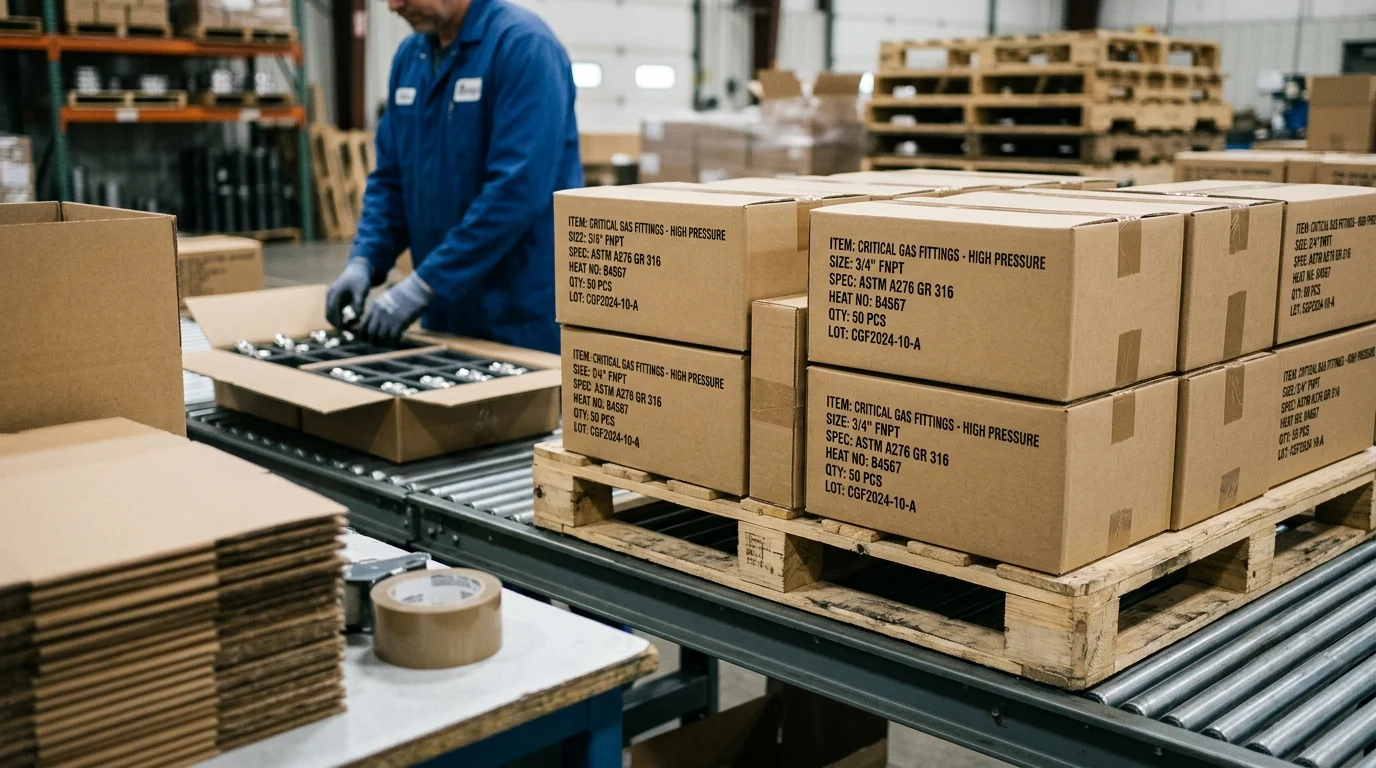
Transitioning a zero-defect philosophy into a physical component requires a rigid framework of specifications. For critical gas fittings, these specifications dictate every aspect of the manufacturing process, from raw material procurement to final packaging, leaving no variable to chance.
Material, Geometry, Threads, and Sealing Surfaces
The foundation of any critical gas fitting is its material. Austenitic stainless steels, specifically 316L Vacuum Induction Melted/Vacuum Arc Remelted (VIM/VAR), are the industry standard due to their exceptional purity, low inclusion content, and resistance to corrosive process gases. The geometry of these fittings frequently involves complex, proprietary metal-to-metal sealing mechanisms, such as VCR or VCO profiles, which demand exacting concentricity and angularity. Threads must be machined to tight-tolerance classes—typically Class 3A/3B—to ensure smooth engagement without particulate generation or galling under high-torque assembly.
Tolerances, Leak-Rate Requirements, and Cleanliness Standards
Dimensional tolerances for critical gas fittings are exceptionally stringent, often held to ±0.005 mm on critical sealing diameters. Surface finish is equally vital; sealing faces generally require a roughness average (Ra) of 0.13 µm (5 µin) or better, often achieved through precision turning followed by electropolishing. These microscopic surface requirements are necessary to meet the stringent 1.0 × 10⁻⁹ atm cc/sec helium leak-rate threshold. Furthermore, cleanliness standards dictate that these components must be free of all hydrocarbon residues and particulate matter, necessitating final processing and packaging in an ISO Class 4 (Class 10) cleanroom environment.
Standard Fittings vs. Critical Gas Fittings
The distinction between standard industrial fluid power fittings and critical gas fittings is profound, impacting both performance capabilities and manufacturing costs.
| Parameter | Standard Industrial Fitting | Critical Gas Fitting (UHP) |
|---|---|---|
| Material | 304 or Standard 316L SS | 316L VIM/VAR SS |
| Surface Finish (Ra) | 0.8 µm to 1.6 µm (32-63 µin) | ≤ 0.13 µm (5 µin) Electropolished |
| Leak Rate Target | 1.0 × 10⁻⁴ atm cc/sec | ≤ 1.0 × 10⁻⁹ atm cc/sec |
| Packaging | Bulk bagging | Double-bagged in ISO Class 4 Cleanroom |
| Cost Multiplier | 1x (Baseline) | 5x to 15x |
Standard fittings rely on elastomeric O-rings or thread sealants, which outgas and degrade, whereas critical fittings utilize precision-machined metal-to-metal deformation to achieve absolute containment.
How CNC Machining Prevents Defects
Achieving the specifications detailed above requires highly controlled CNC machining environments. Zero-defect manufacturing is not achieved through post-process sorting, but through deterministic machining strategies that prevent deviations from occurring in the first place.
Design-for-Manufacturing Review and Tooling Strategy
Defect prevention begins before the first chip is cut, during the Design-for-Manufacturing (DFM) review. Engineers analyze the fitting geometry to identify features prone to vibration, tool deflection, or work-hardening—a common issue with 316L stainless steel. The tooling strategy typically involves custom-ground sub-micrograin carbide cutting tools with specialized PVD coatings to maintain sharp cutting edges and minimize built-up edge (BUE). Rigid workholding, often utilizing custom collets on multi-axis Swiss-type lathes, ensures that the component can be machined in a single operation, eliminating tolerance stacking errors associated with secondary setups.
In-Process Controls for Dimensional Stability
Dimensional stability during the machining cycle is maintained through aggressive in-process controls. Modern CNC centers dedicated to critical gas fittings utilize active thermal compensation to counteract spindle growth and ambient temperature fluctuations. On-machine probing systems verify tool wear and part dimensions between cycles, automatically applying tool offsets to keep dimensions centered within the tolerance band. To guarantee zero defects, manufacturers must maintain high process capability indices, typically targeting a Cpk greater than 1.67 for all critical sealing dimensions, ensuring that the natural process variation is less than half the specified tolerance width.
Deburring, Passivation, Ultrasonic Cleaning, and Drying
The machining process invariably leaves microscopic burrs and surface contaminants that must be eradicated. Deburring critical internal intersecting cross-holes is often accomplished through thermal energy methods (TEM) or electrochemical machining (ECM) to ensure no loose material remains. Following deburring, fittings undergo passivation—typically using nitric or citric acid in accordance with ASTM A967—to strip free iron from the surface and promote a robust chromium oxide layer. The final step involves multi-stage ultrasonic cleaning utilizing 18 Megohm-cm deionized (DI) water, followed by vacuum drying in a controlled environment to eliminate any trace of moisture or chemical residue.
Inspection, Documentation, and Release Controls
A zero-defect claim is meaningless without objective, documented evidence. The inspection and release protocols for critical gas fittings are as rigorous as the machining processes, designed to provide absolute traceability and assurance of compliance.
Inspection Methods for Critical Gas Fittings
Verification of critical gas fittings relies on a combination of advanced metrology and functional testing. Dimensional accuracy and thread profiles are verified using optical comparators and automated vision systems, while surface finish on sealing glands is quantified using non-contact white-light interferometry or precision profilometers. Given the catastrophic consequences of failure, sealing surfaces often undergo 100% visual inspection under stereomicroscopes at 40x magnification to detect micro-scratches. Finally, representative samples from each production lot are subjected to outboard helium mass spectrometry to certify that the metal-to-metal seal meets the required baseline leak rates under operational torque specifications.
Documentation for Traceability and Audit Readiness
Traceability is a non-negotiable requirement for critical gas systems. Every fitting must be traceable back to its original raw material heat lot. This is achieved through comprehensive documentation, starting with EN 10204 Type 3.1 Material Test Reports (MTRs) that verify the chemical composition and mechanical properties of the VIM/VAR stainless steel. First Article Inspection (FAI) reports, formatted to aerospace standards like AS9102, validate the initial production run. Before cleanroom packaging, fittings are permanently laser-marked with a unique heat lot code and manufacturer identification, ensuring full audit readiness and facilitating targeted recalls in the highly unlikely event of a field anomaly.
How to Qualify a Zero-Defect Supplier
Sourcing critical gas fittings introduces substantial risk to OEMs and system integrators. Qualifying a CNC machining partner requires looking beyond standard brochure claims and conducting deep-dive assessments of their quality management systems and operational capabilities.
Supplier Audit Steps for CNC Machining Capability
Auditing a prospective supplier for critical gas fittings involves evaluating their specific competence in ultra-high-purity manufacturing. Auditors must verify active ISO 9001, and often AS9100 or ISO 13485, quality certifications. The audit should scrutinize machine maintenance logs to ensure spindle runout is routinely checked, verify that all metrology equipment is calibrated to ISO/IEC 17025 standards, and review the validation data for their ultrasonic cleaning lines and cleanrooms. A supplier’s ability to demonstrate real-time Statistical Process Control (SPC) data during the audit is a strong indicator of a mature, zero-defect manufacturing culture.
Balancing Price, Lead Time, Quality, and Risk
Procurement teams must navigate complex trade-offs when sourcing these components. The specialized nature of VIM/VAR materials and the extensive processing required mean that critical gas fittings command a significant premium over standard industrial hardware.
| Capability Tier | Typical Tolerance | Cleanroom Packaging | Target Application | Est. Cost Premium |
|---|---|---|---|---|
| Tier 3 (Industrial) | ± 0.05 mm | None (Bulk) | Compressed Air, Water | Baseline (1x) |
| Tier 2 (High Purity) | ± 0.01 mm | ISO Class 7 | Medical Gas, Purge Lines | 3x – 5x |
| Tier 1 (Ultra-High Purity) | ± 0.005 mm | ISO Class 4 | Semiconductor, Toxic Gas | 8x – 15x |
Lead times also present a challenge; securing specialty stainless steel alloys can extend lead times to 8–12 weeks or more. Buyers must balance the necessity of high Minimum Order Quantities (MOQs) required to absorb the cost of complex CNC setups against their own inventory carrying costs and supply chain risks.
Decision Framework for Sourcing and Approval
The final decision framework for approving a zero-defect supplier should be phased. It begins with the evaluation of prototype runs to assess initial quality and communication. This is followed by a formal process capability study, often requiring a Production Part Approval Process (PPAP) Level 3 submission, to prove that the supplier can maintain required Cpk levels over a sustained production run. Only after the supplier has demonstrated consistent compliance with metallurgical, dimensional, and cleanliness standards should they be fully integrated into the approved vendor list for critical gas system components.
Key Takeaways
- Specify helium leak performance at or below 1.0 × 10⁻⁹ atm cc/sec for ultra-high-purity gas fittings to reduce safety, contamination, and downtime risks.
- Use high-purity 316L VIM/VAR stainless steel for critical gas fittings exposed to corrosive, reactive, or ultra-clean gas environments.
- Hold critical sealing diameters to tolerances as tight as ±0.005 mm when the application depends on repeatable metal-to-metal sealing.
- Require sealing face finishes of Ra 0.13 µm, or 5 µin, or better to minimize microscopic leak paths in VCR, VCO, and similar fitting profiles.
- Control thread quality with tight-tolerance classes such as 3A/3B to reduce galling, particulate generation, and inconsistent assembly torque.
- Treat burr removal, cleaning, and final inspection as core manufacturing steps because residual particles can contaminate downstream process chambers.
Frequently Asked Questions
Why do critical gas fittings require zero-defect CNC machining?
Critical gas fittings often handle toxic, reactive, high-purity, or high-pressure gases. Even a tiny scratch, burr, or tolerance error can create a leak path, cause contamination, damage equipment, or interrupt production.
What leak-rate standard is common for ultra-high-purity gas fittings?
Ultra-high-purity gas systems commonly require outboard helium leak rates of 1.0 × 10⁻⁹ atm cc/sec or better, which demands precise sealing geometry, clean surfaces, and rigorous inspection.
Which material is commonly used for high-purity critical gas fittings?
316L VIM/VAR stainless steel is widely used because it offers high purity, low inclusion content, corrosion resistance, and reliable performance in demanding gas delivery environments.
How can machining defects cause gas fitting failure?
Thread galling, burrs, residual particles, micro-scratches, and slight dimensional deviations can prevent proper sealing, create leak paths, contaminate downstream systems, or accelerate seal wear.
What surface finish is typically needed on sealing faces?
Critical sealing faces often require Ra 0.13 µm, or 5 µin, or better. This smoothness helps support reliable metal-to-metal sealing and reduces the risk of microscopic leak paths.
Post time: Jun-26-2026