
Introduction
Threaded pipe fittings are a practical way to join small-bore piping systems without welding, making them common in utilities, instrumentation, and general industrial service. Their performance, however, depends on choosing the right fitting type, thread form, material, and pressure class for the job. This article explains the main categories of threaded fittings, outlines the standards that govern dimensions and sealing, and shows where these components are most often used. By the end, readers will have a clear basis for comparing options, avoiding common specification mistakes, and understanding when threaded connections are suitable versus when another joining method is the better choice.
Why threaded pipe fittings matter
Threaded pipe fittings represent one of the oldest and most reliable methods for assembling piping systems without the need for metallurgical bonding. By utilizing precision-machined internal (female) and external (male) threads, these components facilitate secure, pressure-tight joints across a multitude of industrial environments. They are predominantly deployed in small-bore piping systems, typically restricted to nominal pipe sizes of 2 inches (DN50) and smaller. Beyond this 2-inch threshold, the torque required to properly assemble and seal threaded joints becomes prohibitive, and alternative methods such as flanging or welding become necessary.
The enduring relevance of threaded fittings stems from their unique balance of mechanical strength, adaptability, and ease of assembly. While high-pressure or highly hazardous chemical lines often mandate fully welded construction, threaded connections remain the standard for utility lines, instrumentation, and secondary process systems where operational pressures generally remain below 150 psi for standard applications, or up to 6,000 psi when utilizing specialized heavy-wall forged configurations.
Installation and maintenance advantages
The primary advantage of threaded connections lies in their installation efficiency. Unlike welding, threading requires no hot work permits, specialized ventilation, or highly specialized metallurgical labor. This translates directly to reduced installation times and labor costs, which can be 30% to 50% lower than comparable welded assemblies. Furthermore, threaded systems present zero fire risk during installation, making them ideal for retrofits or expansions within active, hazardous facilities where halting production for hot work is economically unviable.
Maintenance and system modifications also benefit substantially from threaded architectures. When a pipeline requires rerouting, inspection, or component replacement, threaded fittings—particularly unions—allow technicians to dismantle specific sections rapidly without cutting the pipe. This modularity minimizes downtime and allows for the recovery and reuse of expensive valves and instrumentation.
Common industrial applications
Industrial applications for threaded fittings are vast, though they are generally concentrated in utility and auxiliary systems rather than primary hazardous process lines. Cooling water distribution, instrument air networks, and low-pressure steam systems rely heavily on these components. In commercial and industrial fire protection, threaded malleable iron fittings are the ubiquitous standard for sprinkler system branch lines.
Additionally, the oil and gas sector utilizes heavy-duty forged threaded fittings for wellhead instrumentation, chemical injection skids, and hydraulic control lines. In these environments, threaded connections provide the necessary structural integrity to withstand significant operational stresses while allowing for the rapid field assembly required in remote or offshore locations.
Types, threads, and materials
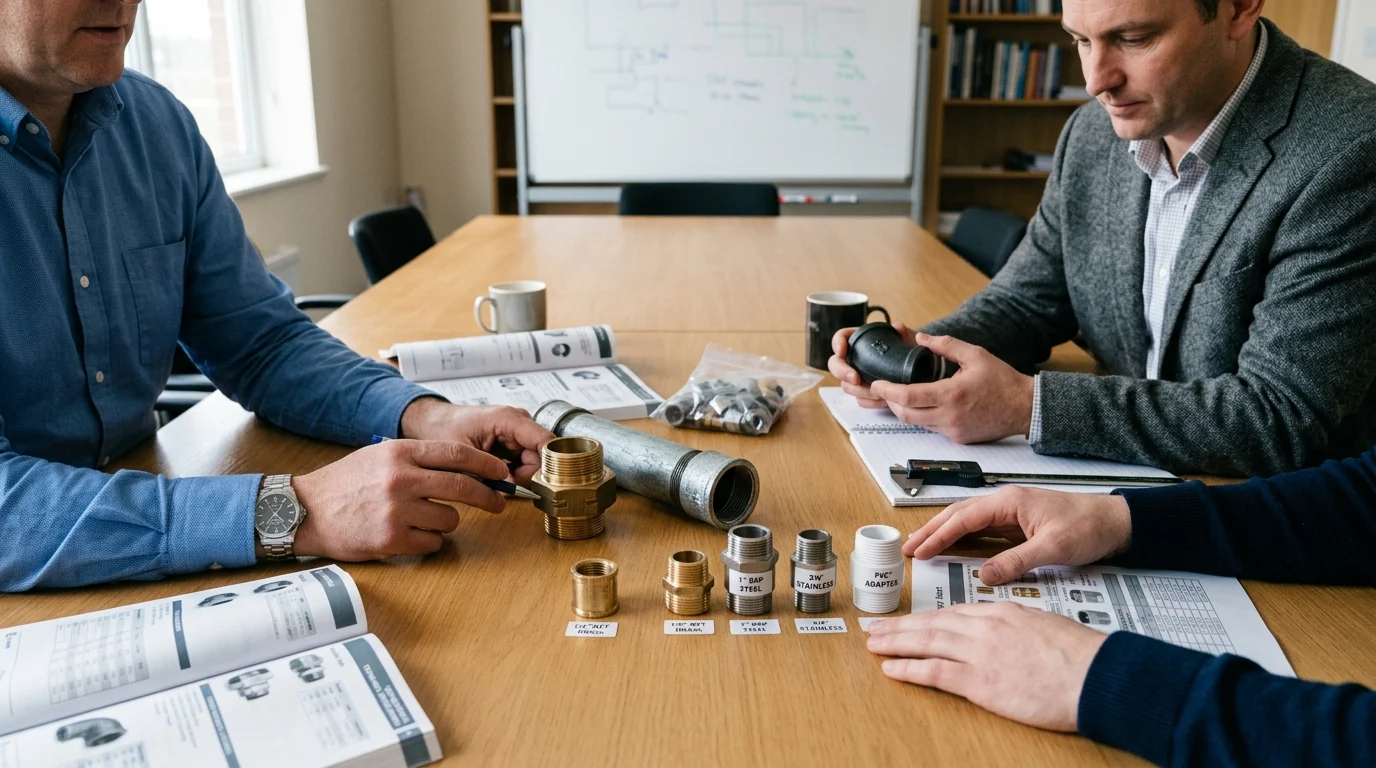
The versatility of a threaded piping system depends entirely on the correct specification of fitting geometries, thread profiles, and metallurgical properties. Selecting the appropriate combination ensures that the pipeline can accommodate necessary directional changes, branch connections, and pressure requirements without compromising flow dynamics or mechanical integrity. Engineers must navigate a matrix of configurations, pressure classes spanning from Class 150 to Class 6000, and diverse thread standards.
Common fitting types
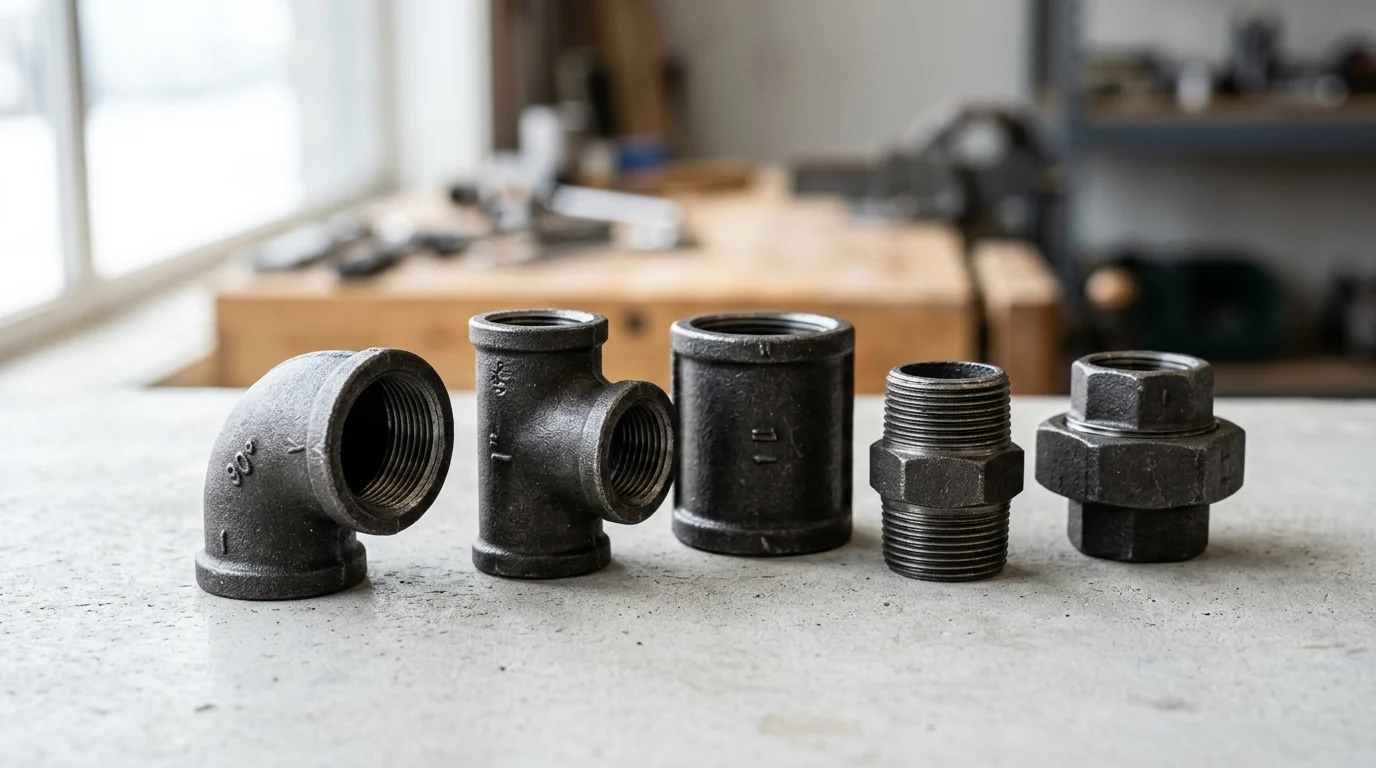
Piping networks require various directional and volumetric adaptations, achieved through specific fitting geometries. Elbows (typically 90° and 45°) facilitate directional changes, while tees and crosses allow for flow distribution and mixing. Couplings connect linear pipe segments, reducers transition between different pipe diameters, and caps or plugs seal terminal ends. Unions are critical components that allow for the disconnection of pipes without rotating the adjacent pipe segments.
| Fitting Type | Primary Function | Typical Flow Resistance (K-factor) |
|---|---|---|
| 90° Standard Elbow | Changes flow direction by 90 degrees | 1.50 |
| Standard Tee | Splits or combines flow streams | 1.80 (Branch flow) |
| Full Coupling | Joins two pipe ends linearly | 0.04 |
| Union | Enables inline system disconnection | 0.04 |
| Hex Bushing | Reduces connection size | 0.05 |
NPT, BSPT, and BSPP differences
The integrity of a threaded joint relies on the specific thread profile used, with NPT (National Pipe Taper), BSPT (British Standard Pipe Taper), and BSPP (British Standard Pipe Parallel) being the global dominant standards. NPT threads, standard in North America, feature a 60-degree thread angle and flattened peaks and valleys. The taper rate is 1 inch in 16 inches, creating an interference fit that seals through metal-to-metal deformation combined with a thread sealant.
Conversely, BSPT threads utilize a 55-degree angle with rounded peaks and valleys. While BSPT also relies on a tapered geometry for sealing, its different angle and pitch make it entirely incompatible with NPT; forcing the two together guarantees leakage and thread damage. BSPP threads, lacking a taper, do not form a seal through thread interference; they require an elastomeric O-ring or a bonded seal washer to prevent fluid escape, making them highly suitable for systems requiring frequent disassembly.
Material and pressure rating choices
Material selection dictates both the corrosion resistance and the pressure-temperature envelope of the fitting. Malleable iron is common for low-pressure commercial plumbing, typically rated for Class 150 or Class 300 applications. For industrial robustness, forged carbon steel (e.g., ASTM A105) is utilized, manufactured in Class 2000, 3000, and 6000 ratings. A Class 3000 forged fitting, for instance, is routinely paired with Schedule 80 pipe for high-pressure industrial applications.
When corrosive media or extreme temperatures are present, austenitic stainless steels like 304/304L and 316/316L are specified. These materials resist oxidation and chemical attack while maintaining mechanical strength at elevated temperatures. For highly specialized environments, exotic alloys such as Monel, Hastelloy, or Duplex stainless steel are deployed, though these can increase component costs by factors of 5 to 10 compared to standard carbon steel.
Standards and compliance
Because threaded fittings are deployed in pressurized environments where failure can lead to severe environmental release, property damage, or injury, they are governed by stringent international standards. These frameworks ensure dimensional uniformity, predictable metallurgical behavior, and reliable pressure containment regardless of the manufacturer’s geographic location. Adherence to these standards guarantees that a fitting procured in one region will seamlessly mate with a pipe threaded in another, maintaining tolerances as tight as +/- 1 thread turn.
Key ASME, ASTM, ISO, EN, and MSS standards
The manufacturing and specification of threaded fittings are heavily regulated by organizations such as ASME, ASTM, ISO, and EN. ASME B16.11 is the definitive standard for forged steel fittings, dictating dimensions, tolerances, and material requirements for socket-welding and threaded configurations. Meanwhile, the thread profiles themselves are governed by ASME B1.20.1 for NPT and ISO 7-1 for BSPT.
| Standard Designation | Governing Body | Primary Scope and Application |
|---|---|---|
| ASME B16.11 | American Society of Mechanical Engineers | Dimensions and ratings for forged steel threaded and socket-welding fittings |
| ASME B1.20.1 | American Society of Mechanical Engineers | Specifications for general-purpose NPT pipe threads |
| ISO 7-1 | International Organization for Standardization | Dimensions and tolerances for pressure-tight tapered pipe threads (BSPT) |
| ASTM A105 / A182 | American Society for Testing and Materials | Material specifications for carbon steel (A105) and stainless/alloy steel (A182) forgings |
| EN 10241 | European Committee for Standardization | Specifications for steel threaded pipe fittings used in European markets |
Certification, traceability, and testing
Compliance extends beyond dimensional accuracy into rigorous material traceability and quality assurance. High-tier industrial projects require Material Test Reports (MTRs) compliant with EN 10204 Type 3.1, which guarantees that the fitting’s chemical composition and mechanical properties have been validated by the manufacturer’s independent testing department. This traceability ensures that carbon equivalents remain within acceptable limits for weldability (if applicable) and structural integrity.
Testing protocols often include Positive Material Identification (PMI) to verify alloy composition, particularly critical for 316 stainless steel to ensure adequate molybdenum content (typically 2.0% to 3.0%) for pitting resistance. Furthermore, while the fittings themselves are not individually hydro-tested by the manufacturer, they are designed to withstand system hydrostatic testing at 1.5 times the maximum design pressure without yielding or leaking.
How to evaluate and source fittings
Procuring threaded pipe fittings requires a strategic approach that balances technical specifications with supply chain realities. Buyers and engineers must evaluate not only the immediate application requirements but also the long-term reliability of the components. A miscalculation in evaluating fitting quality or a failure to anticipate lead times can result in costly project delays or premature system failures.
Application fit and selection factors
The foremost consideration in sourcing is the precise alignment between the fitting and the application’s operational envelope. Temperature limits are critical; for instance, while a carbon steel fitting may withstand high temperatures, the PTFE thread sealant tape commonly used with it typically degrades above 260°C (500°F). In such cases, alternative high-temperature sealants or specialized parallel thread configurations with metallic seals must be evaluated.
Vibration is another critical selection factor. Tapered threaded joints are inherently susceptible to backing off under severe, high-frequency vibration. If a system is subjected to constant mechanical oscillation from pumps or compressors, buyers should evaluate whether threaded fittings are appropriate at all, or if thread-locking compounds and heavier Class 6000 fittings are necessary to provide the required mass and thread engagement depth to resist vibrational loosening.
Quality checkpoints
Robust quality checkpoints must be established during the evaluation phase. Buyers should audit suppliers for precise thread gauging; threads that are cut too deep or too shallow will fail to achieve the necessary interference fit, leading to spiral leaks. Visual inspections should confirm the absence of burrs, tears, or chatter marks on the threads, which indicate poor machining practices and compromised sealing surfaces.
Wall thickness is another critical checkpoint. A Class 3000 fitting must possess sufficient wall thickness to match or exceed the burst pressure of Schedule 80 pipe. Substandard manufacturers may shave wall thicknesses to save on raw material costs. For critical industrial applications, procurement teams should target suppliers demonstrating defect rates consistently below 0.1%, backed by robust ISO 9001 quality management systems.
MOQ, lead time, packaging, and sourcing
Logistics and commercial terms heavily influence sourcing strategies. Standard carbon steel and 304/316 stainless steel fittings generally carry Minimum Order Quantities (MOQs) ranging from 500 to 1,000 pieces for direct factory orders, though distributors often supply smaller batches at a premium. Lead times for standard forged items typically range from 4 to 8 weeks, whereas exotic alloys like Hastelloy can stretch to 12 or 16 weeks due to raw material scarcity.
Packaging is a frequently overlooked sourcing parameter. Carbon steel fittings are highly susceptible to oxidation during maritime transit. Buyers must specify anti-rust treatments, such as light oil coatings, and require export-grade packaging—such as vapor corrosion inhibitor (VCI) bags within heavy-duty wooden crates—to ensure components arrive at the construction site in installation-ready condition.
Specification and buying framework
To mitigate risks associated with incompatible components and supply chain bottlenecks, organizations must implement a standardized specification and buying framework. By formalizing the procurement lifecycle, companies ensure consistency across multiple facilities, reduce total cost of ownership, and align the technical requirements of the engineering department with the commercial realities of the procurement team.
Step-by-step specification process
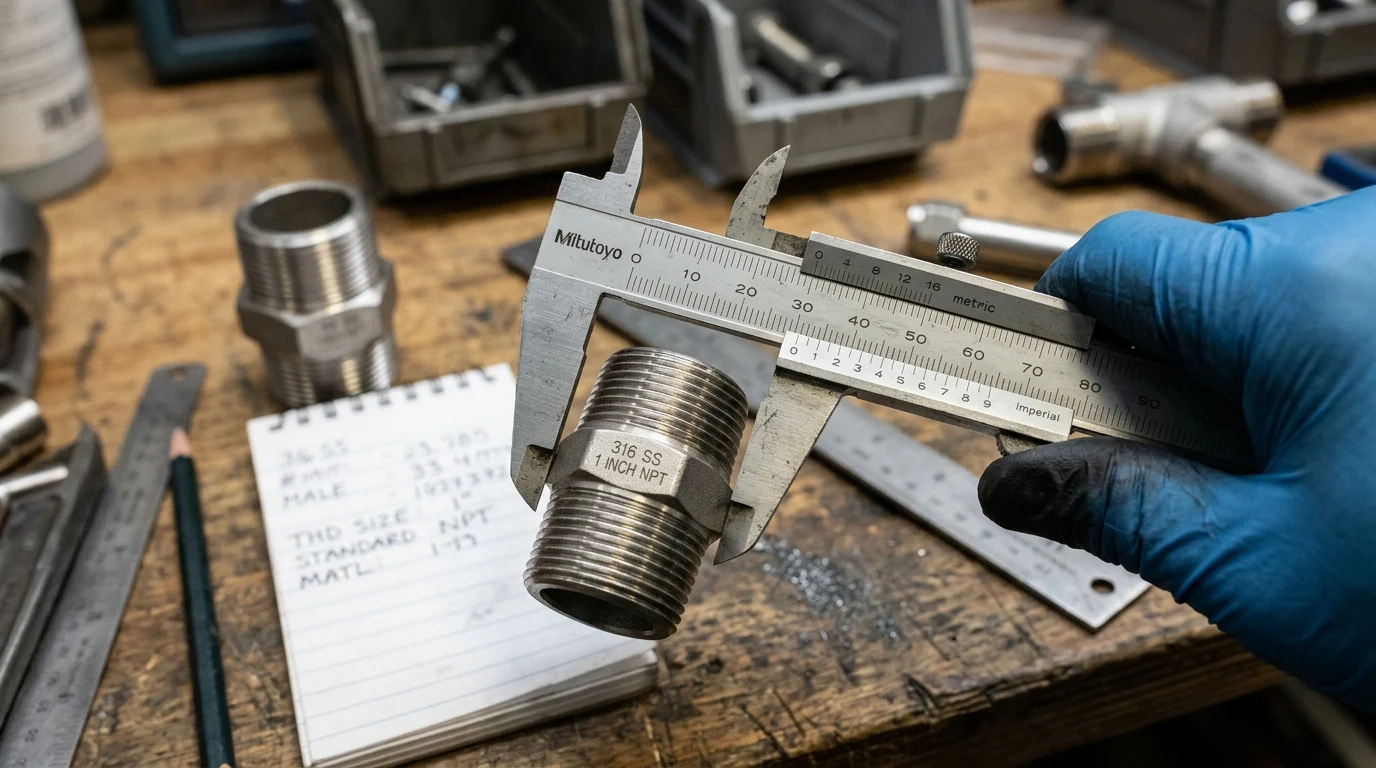
A robust specification process follows a strictly defined, step-by-step methodology. The first step defines the fluid media, operational pressure, and maximum temperature (e.g., saturated steam at 150 PSI). The second step dictates the material grade and pressure class required to safely contain that media. The third step standardizes the thread type (e.g., mandating NPT across a North American facility to prevent cross-threading with BSPT parts).
The fourth step involves detailing the required compliance standards and testing documentation, such as demanding ASME B16.11 compliance and EN 10204 3.1 MTRs. Finally, the fifth step requires a technical review where the specified fittings are validated against the pipe schedule being used, ensuring that a high-pressure Class 3000 fitting is not erroneously paired with a thin-walled Schedule 10 pipe, which would create a dangerous weak point in the thread root.
Roles of engineering, distribution, and procurement
Successful procurement relies on the synchronized efforts of engineering, distribution, and procurement teams.
Key Takeaways
- The most important conclusions and rationale for threaded pipe fittings
- Specs, compliance, and risk checks worth validating before you commit
- Practical next steps and caveats readers can apply immediately
Frequently Asked Questions
What pipe size is best suited for threaded pipe fittings?
They are typically used on small-bore lines up to 2 inches (DN50). Above that size, assembly torque and leak risk increase, so flanged or welded joints are usually preferred.
What are the most common types of threaded pipe fittings?
Common types include elbows, tees, couplings, reducers, caps, plugs, bushings, and unions. Each serves a specific function such as changing direction, branching flow, joining pipe, or allowing easy disassembly.
How do NPT, BSPT, and BSPP threads differ?
NPT uses a 60° tapered thread common in North America. BSPT is 55° tapered, while BSPP is 55° parallel and usually seals with a washer or O-ring. Do not mix standards.
Where are threaded pipe fittings commonly used?
They are common in cooling water, instrument air, low-pressure steam, sprinkler branch lines, and oilfield instrumentation or hydraulic control lines where quick assembly and maintenance are important.
How can I choose the right threaded fittings supplier for my project?
Check that the supplier offers the needed thread standard, pressure class, and material, plus consistent machining quality. On nbfh-metal.com, review the product range and factory capabilities before requesting specifications or a quote.
Post time: May-13-2026