
Introduction
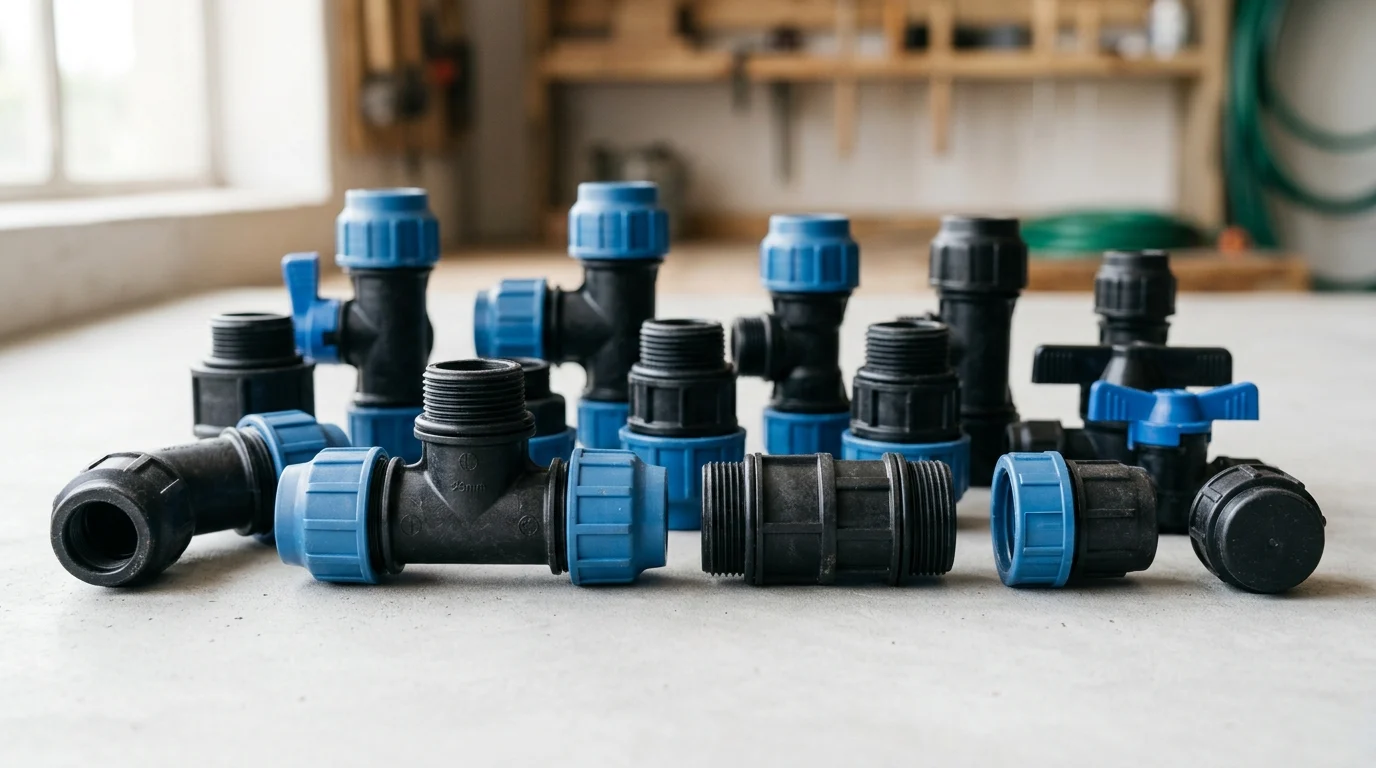
Choosing fittings is not a minor detail in an irrigation system; it affects flow balance, pressure loss, leak risk, maintenance frequency, and long-term operating cost. The right elbow, tee, reducer, coupling, or valve connection helps water move efficiently while keeping the network durable under field, landscape, or commercial use conditions. This guide explains the main types of irrigation pipe fittings, compares common materials such as PVC, polyethylene, and metal, and shows how to evaluate pressure, compatibility, environment, and installation demands. With that foundation, the rest of the article will help you make practical fitting selections that support reliable performance and lower lifecycle cost.
Why do irrigation pipe fittings matter for system performance and
Irrigation pipe fittings serve as the critical junctions within agricultural, commercial, and residential water delivery networks. While pipes transport the bulk volume of water, fittings dictate the directional flow, pressure regulation, and structural integrity of the entire system. Because they represent the primary points of vulnerability in any fluid conveyance setup, their selection directly impacts both immediate performance metrics and long-term operational expenditures.
In large-scale agricultural and commercial landscaping operations, the capital expenditure on fittings may only represent 5% to 10% of the total irrigation materials budget. However, poor fitting selection can inflate operational costs exponentially over the system’s lifecycle through pressure drops, structural failures, and water loss.
How do irrigation pipe fittings influence hydraulic efficiency?
The primary function of any irrigation network is the uniform distribution of water at specific pressures, a metric heavily dependent on hydraulic efficiency. Every time water passes through a fitting—whether an elbow, tee, or reducer—it encounters friction and turbulence. Substandard irrigation pipe fittings with internal burrs, sharp directional transitions, or mismatched internal diameters can increase localized friction loss by 10% to 15%.
This compounded pressure drop across hundreds of nodes forces irrigation pumps to work harder to maintain terminal pressure at the sprinkler heads or drip emitters. Consequently, systems with hydraulically inefficient fittings can experience an energy consumption increase of up to 20%, significantly elevating the kilowatt-hour (kWh) costs required to move the same volume of water per hectare.
Which commercial factors make fitting selection critical in agriculture?
In commercial agriculture, the financial implications of fitting failure extend far beyond the cost of replacement parts. A primary driver of operational expense is water waste. For example, a single 2-millimeter leak at a compromised fitting operating at 45 psi (approximately 3 bar) can waste over 200 gallons of water per day. In a system with hundreds of such connections, the aggregate water loss drastically inflates utility costs and depletes allocated water quotas.
Furthermore, catastrophic fitting blowouts can cause localized flooding, leading to soil erosion, crop root disease, and yield reduction. The labor costs associated with excavating and repairing a failed subsurface main line fitting often exceed the unit cost of the fitting by a factor of 50 to 100, making upfront investments in high-tolerance, application-specific components a critical commercial strategy.
What types of irrigation pipe fittings are used in modern
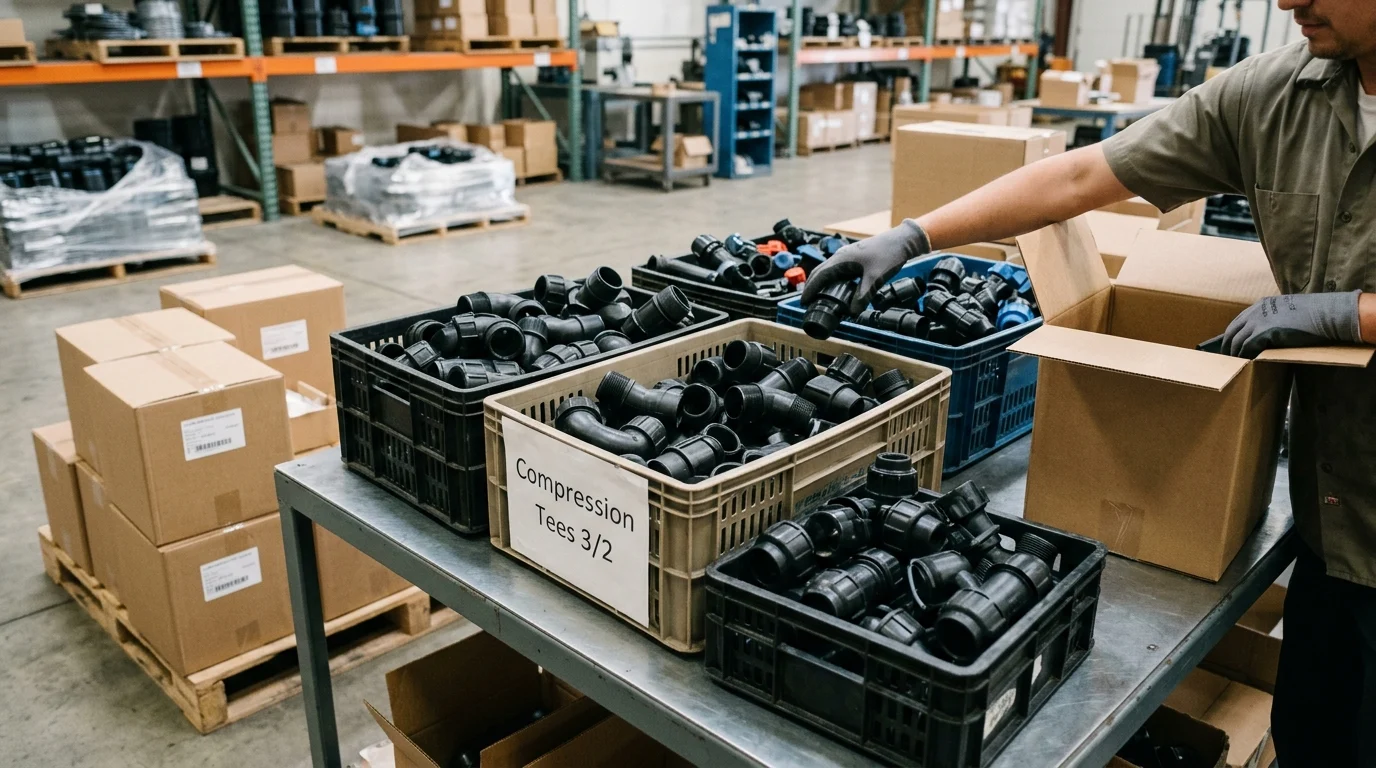
Modern fluid delivery systems rely on a diverse array of irrigation pipe fittings to accommodate varying pressure zones, terrain layouts, and emission devices. Understanding the structural categorizations and connection mechanisms is essential for engineering a leak-free network.
How are irrigation pipe fittings classified by function: connectors, adapters, and ends?
Irrigation pipe fittings are fundamentally categorized by their role within the network architecture. Connectors, including couplers, elbows, and tees, are designed to extend pipe runs, navigate corners, and branch main lines into secondary laterals. Adapters serve as transition points, allowing operators to switch between different pipe materials (e.g., PVC to HDPE) or connection methods (e.g., slip-fit to threaded).
End fittings, such as caps and plugs, terminate the flow of water at the end of a lateral line, enabling the system to build and maintain necessary operational pressure. Specialized functional fittings, like reducing tees, simultaneously branch a line while decreasing the pipe diameter to maintain velocity as water volume drops.
What are the key comparison points for threaded, compression, and push-fit fittings?
The method by which a fitting secures to the pipe dictates its installation speed, reusability, and maximum pressure rating. Threaded fittings require rotational engagement and thread sealants; compression fittings utilize a tightened nut to compress an internal ferrule against the pipe wall; and push-fit fittings rely on an internal O-ring and stainless-steel grip ring for instantaneous connection.
| Connection Type | Typical Pressure Rating | Installation Speed | Reusability | Ideal Application |
|---|---|---|---|---|
| Threaded (NPT/BSP) | Up to 150 psi | Moderate | High | Pump stations, valves |
| Compression | Up to 200 psi | Slow | Moderate | High-pressure mainlines |
| Push-Fit | Up to 100 psi | Fast | Low | Residential, quick repairs |
| Solvent Weld (Slip) | Up to 200+ psi | Moderate | None | Permanent PVC networks |
Commercial operators must weigh the labor savings of push-fit systems against the robust, high-pressure reliability of compression or solvent-welded joints.
Which system-specific requirements differentiate drip, sprinkler, and micro-irrigation fittings?
System architecture heavily dictates fitting selection. Drip irrigation systems operate at low pressures—typically between 15 and 30 psi—and utilize specialized barbed fittings. These fittings feature angled ridges that grip the internal diameter of soft polyethylene (PE) tubing without the need for clamps or glue.
Conversely, overhead sprinkler systems and agricultural impact rotors demand mainlines operating between 40 and 80 psi. These systems require heavy-duty PVC or HDPE compression fittings capable of withstanding constant hydrostatic pressure and water hammer effects. Micro-irrigation relies on micro-fittings (often 4mm to 6mm in diameter) that must be precision-molded to prevent clogging from particulate matter while maintaining tight seals under low-flow conditions.
Which materials for irrigation pipe fittings deliver the best balance
The longevity and reliability of an irrigation system are inextricably linked to the material composition of its fittings. Selecting the appropriate polymer or metal requires an analysis of environmental exposure, fluid dynamics, and budgetary constraints.
How do PVC, CPVC, HDPE, PP, acetal, nylon, and brass compare?
The irrigation industry utilizes a spectrum of plastics and metals, each engineered for specific operational thresholds. Polyvinyl Chloride (PVC) remains the standard for rigid, high-pressure mainlines, while High-Density Polyethylene (HDPE) dominates flexible, impact-resistant applications. Polypropylene (PP) is frequently used for durable compression fittings due to its mechanical strength.
| Material | Max Operating Temp | UV Resistance | Corrosion Resistance | Relative Cost |
|---|---|---|---|---|
| Standard PVC | 140°F (60°C) | Low (requires coating) | Excellent | Low |
| CPVC | 200°F (93°C) | Moderate | Excellent | High |
| HDPE | 140°F (60°C) | High (with Carbon Black) | Excellent | Moderate |
| Acetal / POM | 180°F (82°C) | Moderate | High | Moderate |
| Brass | 400°F+ (204°C) | Excellent | Moderate (dezincification risk) | Very High |
Nylon and acetal are commonly deployed in micro-irrigation valves and barbed fittings due to their high tensile strength and resistance to mechanical wear, whereas brass is reserved for high-stress transition points, such as pump discharge manifolds.
What pressure, UV, water chemistry, and temperature factors affect material choice?
Environmental and chemical factors dictate the operational limits of these materials. Standard PVC experiences a significant reduction in pressure handling capability as temperatures rise; a PVC fitting rated for 150 psi at 73°F will only support approximately 33 psi at 140°F. Furthermore, standard plastics degrade under prolonged ultraviolet (UV) exposure, becoming brittle over time. HDPE fittings formulated with 2% to 3% carbon black offer superior UV stabilization for above-ground deployment.
Water chemistry also plays a critical role. Agricultural water containing high levels of dissolved fertilizers (fertigation) or harsh soil treatments can cause chemical degradation in lower-grade plastics. In regions with aggressive, acidic water or high chloride content, brass fittings may suffer from dezincification, prompting a shift toward high-grade engineered polymers or stainless steel for critical junctions.
Which comparison criteria should buyers use to evaluate service life and total cost?
Procurement professionals must evaluate service life against initial capital outlay. While brass fittings cost 4x to 5x more than their PVC counterparts, their 30-to-50-year lifespan and immunity to UV degradation often justify the expense for exposed, high-traffic valves and pump connections.
For expansive 100-acre agricultural plots, however, the scalability of plastics is unmatched. High-quality PP compression fittings or Schedule 80 PVC fittings offer a 15-to-25-year service life when buried below the frost line, providing the optimal balance of total cost of ownership (TCO) and reliable field performance.
How should buyers select irrigation pipe fittings for performance and
Procuring the right irrigation pipe fittings requires a systematic approach to specification, quality assurance, and supply chain management. Buyers must navigate a complex landscape of sizing standards and regional compliance metrics to ensure seamless integration.
What step-by-step process helps match fittings to pipe size, pressure, and application?
The specification process begins with aligning the fitting to the pipe’s dimensional standard. Buyers must differentiate between Iron Pipe Size (IPS), Copper Tube Size (CTS), and metric sizing. For PVC, matching the schedule (e.g., Schedule 40 vs. Schedule 80) is crucial, as Schedule 80 fittings feature a thicker wall to handle higher pressures (up to 850 psi for small diameters) and are typically required for industrial agricultural applications.
When sizing HDPE, buyers must reference the Standard Dimension Ratio (SDR). An SDR 11 pipe requires fittings specifically engineered to match its wall thickness and pressure rating (typically 160 psi to 200 psi). Attempting to force a mismatched fitting onto a pipe, or relying on heavy solvent application to bridge a gap, inevitably leads to joint failure.
How should purchasers assess dimensional tolerances, sealing quality, and compatibility?
Quality assurance in fitting procurement hinges on dimensional tolerances. Premium injection-molded fittings adhere to strict manufacturing tolerances, often within ±0.1 millimeters. Buyers should request technical data sheets confirming these specs, as excessive variance leads to dry fits that fail to bond properly during solvent welding, or compression fittings that slip under pressure.
Sealing quality is equally critical for mechanical joints. Buyers must assess the composition of internal O-rings; Nitrile (Buna-N) is standard for water, but EPDM O-rings are necessary if the irrigation water carries harsh agricultural chemicals or fertilizers. Evaluating the compression ratio (typically 15% to 20% deformation) of these seals ensures long-term leak prevention.
What sourcing, packaging, lead-time, and regional compliance issues matter most?
Commercial sourcing introduces logistical and compliance variables. Manufacturers typically enforce Minimum Order Quantities (MOQs) ranging from 1,000 to 5,000 units for specialized or custom-molded fittings. Buyers must factor in production and shipping lead times, which can stretch from 4 to 8 weeks for international freight.
Regional compliance is a non-negotiable sourcing criterion. In North America, fittings must often comply with ASTM D2466 (for Schedule 40 PVC) or ASTM D2467 (for Schedule 80). In Europe and international markets, ISO 14236 (for PE compression fittings) is the prevailing standard. Ensuring ISO 9001 certification from the manufacturing facility guarantees consistent batch-to-batch quality control.
What selection practices reduce failures in irrigation pipe fittings
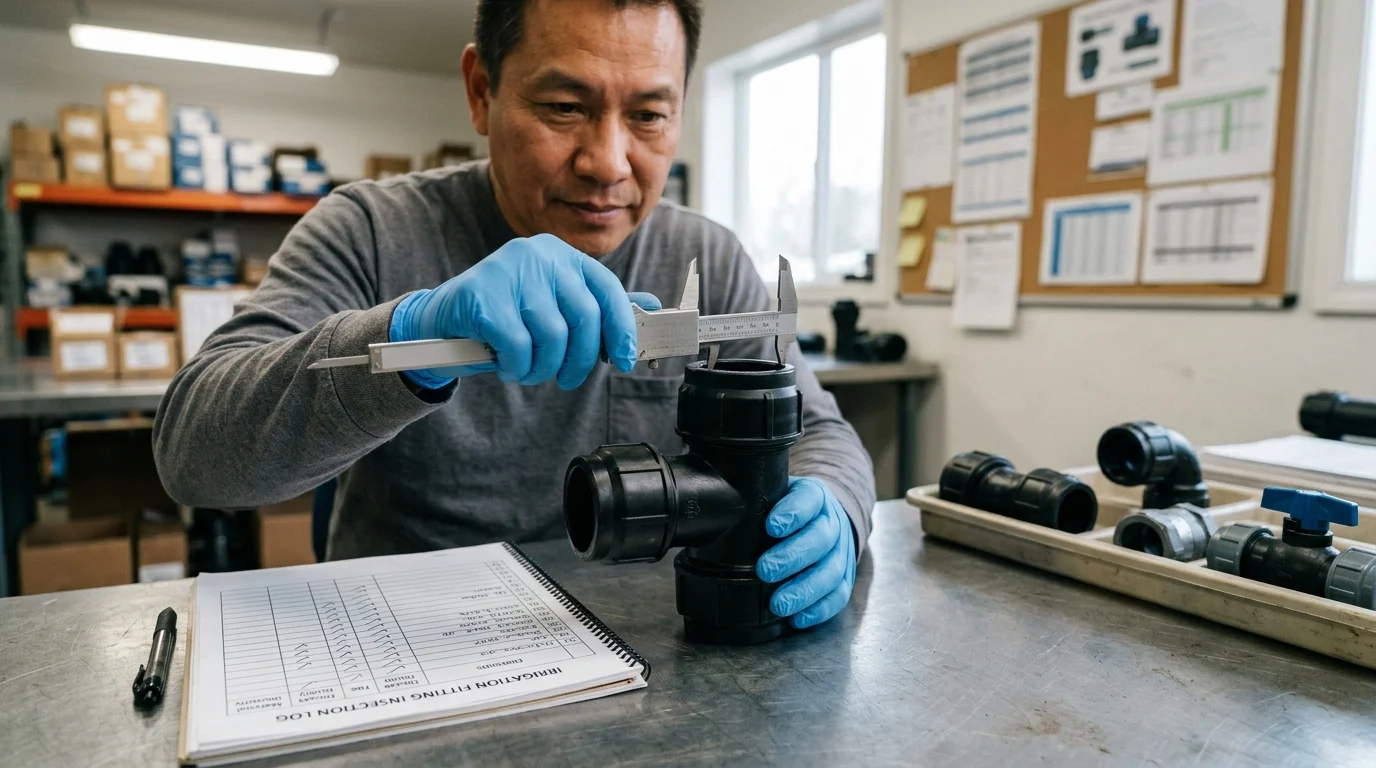
Even the highest-grade irrigation pipe fittings will fail if subjected to improper specification or flawed installation practices. Understanding common failure modes allows system designers and installers to implement protocols that drastically reduce maintenance overhead and downtime.
Which specification and installation mistakes most often lead to leaks?
The majority of fitting leaks stem from poor installation technique rather than material defects. With threaded connections (NPT or BSP), a leading cause of failure is over-tightening. Installers utilizing mechanical wrenches rather than hand-tightening often exceed the recommended 1 to 1.5 turns past finger-tight. This exerts immense radial stress on female plastic threads, leading to micro-fissures that propagate into catastrophic splits under hydraulic pressure.
In solvent-welded systems, neglecting proper curing time is a primary culprit. Subjecting a newly glued PVC joint to operational pressures (e.g., 60 psi) before the mandatory 24-hour curing window disrupts the chemical bond, resulting in slow, persistent leaks. Similarly, failing to use a primer on Schedule 80 fittings prevents the cement from adequately softening the polymer surface, reducing the joint’s burst strength by up to 50%.
How should decision-makers balance lowest price against reliability and lifecycle cost?
Decision-makers often face pressure to reduce capital expenditures by sourcing the cheapest available components. However, value engineering must account for lifecycle reliability. Opting for a low-grade polypropylene fitting to save $0.20 per unit can be disastrous if that fitting blows out on a main lateral.
A single mainline blowout can result in a $500 to $1,000 emergency repair bill, coupled with the unquantifiable cost of crop
Key Takeaways
- The most important conclusions and rationale for irrigation pipe fittings
- Specs, compliance, and risk checks worth validating before you commit
- Practical next steps and caveats readers can apply immediately
Frequently Asked Questions
Why are irrigation pipe fittings so important to system efficiency?
They control flow direction, sealing, and pressure loss. Well-matched fittings reduce turbulence, help maintain uniform water delivery, and can lower pump energy use and leak-related water waste.
Which irrigation fitting type is best for high-pressure mainlines?
Compression fittings are a strong choice for high-pressure mainlines, often rated up to 200 psi. Use them where secure sealing and durability matter more than installation speed.
When should I use push-fit fittings in an irrigation system?
Use push-fit fittings for fast residential installs or emergency repairs. They connect quickly with an O-ring seal, but they are usually better for lower-pressure applications than heavy-duty mainlines.
How do I choose between threaded and compression fittings?
Choose threaded fittings for valves, pump stations, and reusable connections. Choose compression fittings when you need a tighter seal and higher pressure performance on mainlines or demanding outdoor systems.
Can NBFH Metal help with fitting selection for different pipe materials?
Yes. NBFH Metal offers fitting options for varied connection methods and can support selection when transitioning between pipe materials or choosing compression and push-fit solutions for irrigation systems.
Post time: May-09-2026