
Introduction
Reliable fluid systems depend on connections that seal securely, install quickly, and remain serviceable under pressure. Compression pipe fittings meet those demands by using mechanical force rather than welding or heat, making them common in instrumentation, process lines, water systems, and gas service. This article explains the main fitting types, where each is typically used, and the practical factors that affect performance, including tubing material, pressure rating, temperature range, and maintenance needs. By the end, you’ll have a clear framework for comparing options and selecting a fitting that matches both the application and the operating environment.
Why do compression pipe fittings matter in modern fluid handling
Modern fluid handling systems demand robust, leak-tight connections capable of withstanding extreme operational stresses. Compression pipe fittings have emerged as a critical component in these networks, providing a mechanical seal that does not rely on heat or complex threading. By utilizing a nut and one or more ferrules to compress against the tubing exterior, these fittings create a continuous, pressure-resistant seal.
The significance of these fittings lies in their versatility and high-pressure tolerance. Depending on the material and design, high-performance compression fittings can safely manage working pressures exceeding 10,000 PSI (689 bar). This capability makes them indispensable in environments where volatile, toxic, or high-value fluids are transported, and where a catastrophic leak could result in severe safety hazards or costly downtime.
How do compression pipe fittings reduce installation time and maintenance?
One of the primary advantages of compression pipe fittings is the sheer speed of assembly. Traditional joining methods, such as welding, require specialized labor, extensive surface preparation, and the acquisition of hot work permits. By eliminating these requirements, compression fittings can yield a 50% to 70% reduction in installation time.
Maintenance cycles also benefit significantly from mechanical fitting designs. When system modifications or repairs are necessary, compression fittings can be disassembled and reassembled with relative ease, often requiring only a replacement ferrule rather than a complete pipe cut and re-weld. This modularity reduces system downtime from days to mere hours, directly impacting the operational bottom line.
Where are compression pipe fittings most commonly specified across industries?
The adoption of compression pipe fittings spans a diverse array of demanding industries. In the oil and gas sector, they are universally specified for offshore platforms, refineries, and subsea control panels where vibration and extreme pressures are constant. Chemical processing plants rely on them to handle aggressive solvents and corrosive acids safely.
Beyond heavy industry, these fittings are heavily utilized in analytical instrumentation, semiconductor manufacturing, and aerospace applications. In these fields, tubing sizes typically range from miniature 1/16-inch outer diameter (OD) lines for precision gas chromatography up to 2-inch OD lines for bulk fluid transfer. The ability to maintain ultra-high purity (UHP) standards without introducing weld slag or thread sealants makes them the standard for critical fluid transport.
What are compression pipe fittings, and which types and materials

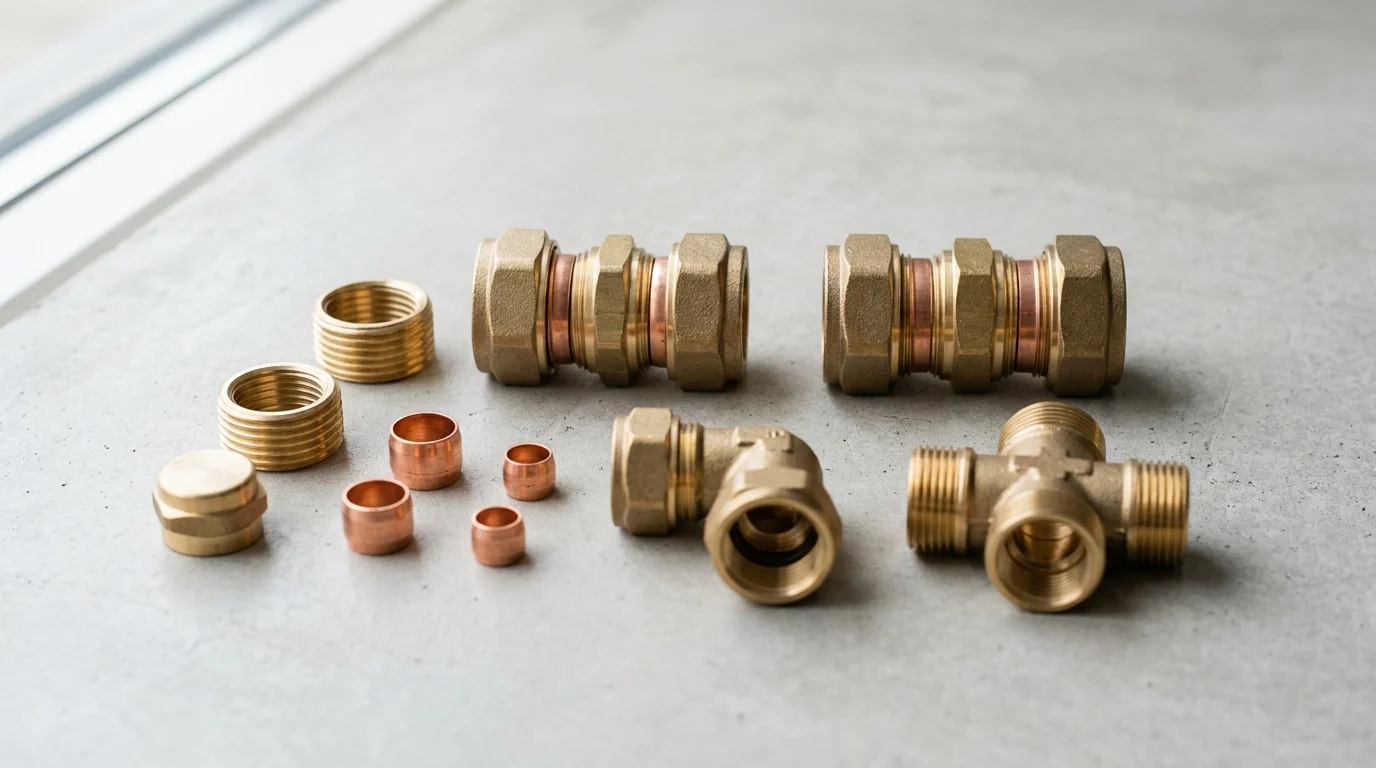
At their core, compression pipe fittings consist of three primary components: the fitting body, the nut, and the ferrule (or ferrule set). When the nut is tightened onto the body, it forces the ferrule into a tapered area of the body. This action causes the ferrule to plastically deform and bite into the tubing, creating both a primary seal and a strong mechanical hold that resists tubing blow-out under pressure.
What are the main types of compression pipe fittings?
The industry primarily categorizes compression fittings into two distinct designs: single-ferrule and double-ferrule systems. Single-ferrule fittings utilize a solitary compression ring that bites into the tube to provide both the sealing and gripping functions. They are generally more prone to operator error during installation but are cost-effective for lower-pressure applications.
Double-ferrule fittings separate these functions. The front ferrule creates the leak-tight seal against the fitting body and the tube OD, while the back ferrule advances the front ferrule and provides a strong mechanical grip on the tube. This dual-action design offers superior vibration resistance and compensates for minor variations in tube wall thickness and hardness, making it the preferred choice for high-pressure and critical applications.
Which materials are best suited for compression pipe fittings?
Material selection dictates a fitting’s chemical compatibility, temperature limits, and structural integrity. 316/316L stainless steel is the industry standard for industrial applications due to its excellent strength and corrosion resistance. For highly corrosive environments, such as sour gas handling, exotic alloys like Monel 400, Hastelloy C-276, and Titanium are specified.
Brass is frequently used in pneumatic systems and low-pressure water applications due to its machinability and lower cost. For environments where metal cannot be used, such as ultra-pure chemical handling, fluoropolymers like PTFE or PFA are utilized.
| Material | Max Operating Temp | Corrosion Resistance | Typical Cost Index (Base 1.0) |
|---|---|---|---|
| Brass | 400°F (204°C) | Low to Moderate | 0.5 |
| 316L Stainless Steel | 1000°F (537°C) | High | 1.0 |
| Monel 400 | 800°F (426°C) | Very High (Marine/HF) | 4.5 |
| PTFE (Teflon) | 400°F (204°C) | Excellent (Chemical) | 2.5 |
What technical factors define performance, including pressure range and temperature?
Performance is heavily dictated by the interplay between pressure, temperature, and tubing specifications. As operating temperatures increase, the allowable working pressure of the tubing and the fitting decreases. For instance, a 316 stainless steel fitting rated for 5,000 PSI at room temperature may only be rated for 3,500 PSI at 800°F (426°C) due to the material’s derating factor.
Furthermore, the tubing wall thickness must align with the fitting design. If the tube wall is too thin, the ferrule may crush the tube rather than gripping it; if it is too thick, the ferrule may not achieve sufficient bite. Manufacturers provide comprehensive tubing data tables specifying the acceptable minimum and maximum wall thicknesses for each OD size to guarantee a 4:1 safety factor.
How do compression pipe fittings compare with threaded, soldered, and
Engineers must constantly evaluate the trade-offs between various joining methodologies. While welding offers a permanent, theoretically leak-free joint, it introduces significant logistical complexities. Threaded connections are simpler but are notorious for developing leaks under vibration and thermal cycling. Compression pipe fittings sit at the intersection of mechanical reliability and ease of assembly, offering a compelling alternative to traditional methods.
What comparison points should buyers evaluate: installation skill, cost, and reliability?
When evaluating joining methods, buyers must consider the holistic cost of the connection. Welding requires highly skilled, certified personnel, expensive capital equipment, and often mandates non-destructive testing (NDT) such as X-ray inspection. Even with strict protocols, weld defect rates can reach 2% to 5% in complex field installations, requiring costly rework.
Threaded fittings, while requiring minimal skill and tooling, rely on thread sealants or PTFE tape that can degrade over time, leading to a high lifecycle maintenance burden. Compression fittings require moderate training—typically a short certification course on proper tightening procedures, such as the standard “1-1/4 turns past finger-tight” rule. The initial component cost of a compression fitting is higher than a threaded equivalent, but the total installed cost is frequently lower due to labor savings.
What table best summarizes the trade-offs between compression pipe fittings and alternatives?
The following table outlines the primary differences between common pipe and tube joining methodologies, aiding specifiers in selecting the optimal approach for their fluid system.
| Joining Method | Installation Speed | Hot Work Required | Vibration Resistance | Typical Defect / Leak Rate (Field) |
|---|---|---|---|---|
| Compression Fitting | Fast (Minutes) | No | High (Double Ferrule) | < 1% (with proper training) |
| Threaded (NPT) | Fast (Minutes) | No | Low | 5% – 10% (Lifecycle) |
| Soldered / Brazed | Moderate | Yes | Moderate | 2% – 4% |
| Welded (TIG/Orbital) | Slow (Hours) | Yes | Very High | 1% – 5% (Pre-NDT) |
How should specifiers and buyers choose the right compression pipe
Selecting the correct compression pipe fitting requires a systematic approach to ensure safety, compatibility, and supply chain efficiency. Procurement teams and engineers must collaborate to define the technical parameters before navigating the vendor landscape. Overlooking a single variable, such as system vibration or localized galvanic corrosion, can lead to premature failure.
What step-by-step selection process helps match compression pipe fittings to the application?
The selection process begins with defining the system media, which dictates the material of the fitting and the ferrule. Next, engineers must calculate the maximum system pressure and temperature to apply the correct material derating factors. A standard industry practice is to maintain a 4:1 safety factor based on the burst pressure of the tubing.
The third step involves matching the fitting to the exact tubing specifications. A critical rule in compression fitting specification is the hardness differential: the tubing must be softer than the fitting material to allow the ferrule to bite effectively. For example, in stainless steel systems, the tubing should generally not exceed a hardness of 80 HRB on the Rockwell scale.
Which compliance, certification, and quality control requirements matter most?
Regulatory compliance and quality assurance are non-negotiable in critical fluid systems. Specifiers should look for fittings manufactured under strict ISO 9001 quality management systems. For pressure-containing components, adherence to standards such as ASME B31.1 (Power Piping) and ASME B31.3 (Process Piping) is essential.
In the oil and gas sector, materials must often comply with NACE MR0175 / ISO 15156, which dictates requirements for metals exposed to sour gas (hydrogen sulfide) to prevent sulfide stress cracking. Additionally, buyers should mandate the provision of Material Test Reports (MTRs) to ensure full traceability of the alloy chemistry from the foundry to the final machined product.
What sourcing and supply considerations affect supplier selection?
Supply chain dynamics play a significant role in the procurement of compression pipe fittings. While standard 316L stainless steel fittings in common sizes (e.g., 1/4″, 3/8″, 1/2″) are typically available off-the-shelf, exotic alloys like Super Duplex or Titanium can carry lead times of 8 to 12 weeks.
Buyers must also navigate Minimum Order Quantities (MOQs). Custom configurations or non-standard materials often trigger MOQs ranging from 100 to 500 units, which can impact project budgets if only a small volume is required. Establishing a relationship with a supplier that holds deep inventory or offers vendor-managed inventory (VMI) programs can mitigate these supply constraints.
What decision criteria lead to the right compression pipe fitting
The final decision on fluid system connections rests on balancing immediate capital expenditure against long-term operational viability. While standardizing on compression pipe fittings represents a strategic investment, it requires a clear understanding of total cost of ownership (TCO) and rigorous adherence to engineering best practices.
How should project teams balance upfront price against reliability and lifecycle cost?
Project teams frequently encounter a “sticker shock” when comparing the unit price of a double-ferrule stainless steel compression fitting to a standard carbon steel threaded fitting, with premiums often exceeding 20% to 30%. However, this upfront price differential is rapidly offset by the reduction in specialized labor hours.
Furthermore, lifecycle cost analysis heavily favors compression fittings in dynamic environments. The cost of a single fugitive emission leak—measured in lost product, environmental fines, and emergency maintenance hours—can easily exceed the entire procurement budget for a skid’s worth of fittings. By engineering out the leak points inherent in threaded systems, facilities realize a lower TCO over a typical 15-to-20-year plant lifecycle.
What final guidance helps determine when compression pipe fittings are the best option?
To finalize the decision, specifiers should utilize a strict application checklist. If the system involves hazardous media, high vibration, operating pressures above 500 PSI, or requires frequent disassembly for maintenance, compression pipe fittings are highly recommended. Conversely, for static, low-pressure utility water lines where maintenance is rare, lower-cost alternatives may suffice.
Ultimately, the success of a compression fitting system relies on component compatibility. The golden rule of the industry is to avoid intermixing components—such as nuts, ferrules, and bodies—from different manufacturers. Even a dimensional variance of 0.001 inches between competing brands can compromise the mechanical seal, void warranties, and introduce critical failure points into the fluid handling system.
Key Takeaways
- The most important conclusions and rationale for compression pipe fittings
- Specs, compliance, and risk checks worth validating before you commit
- Practical next steps and caveats readers can apply immediately
Frequently Asked Questions
What is the main advantage of compression pipe fittings?
They create a leak-tight, high-pressure seal without welding or complex threading, which speeds installation and simplifies maintenance.
When should I choose a double-ferrule fitting?
Use double-ferrule fittings for high-pressure, vibration-prone, or critical fluid systems because they provide better grip and sealing reliability than single-ferrule designs.
Which material is best for compression pipe fittings?
316/316L stainless steel suits most industrial uses; brass fits low-pressure air or water; Monel, Hastelloy, titanium, PTFE, or PFA are better for highly corrosive or ultra-pure media.
Where are compression pipe fittings commonly used?
They are widely used in oil and gas, chemical processing, instrumentation, semiconductor, and aerospace systems where leak prevention and clean connections are essential.
How can I choose the right compression fitting from nbfh-metal.com?
Match the fitting to your tube OD, pressure, temperature, media, and vibration level, then select a compatible material and ferrule design from NBFH Metal’s compression fittings range.
Post time: May-11-2026