
Introduction
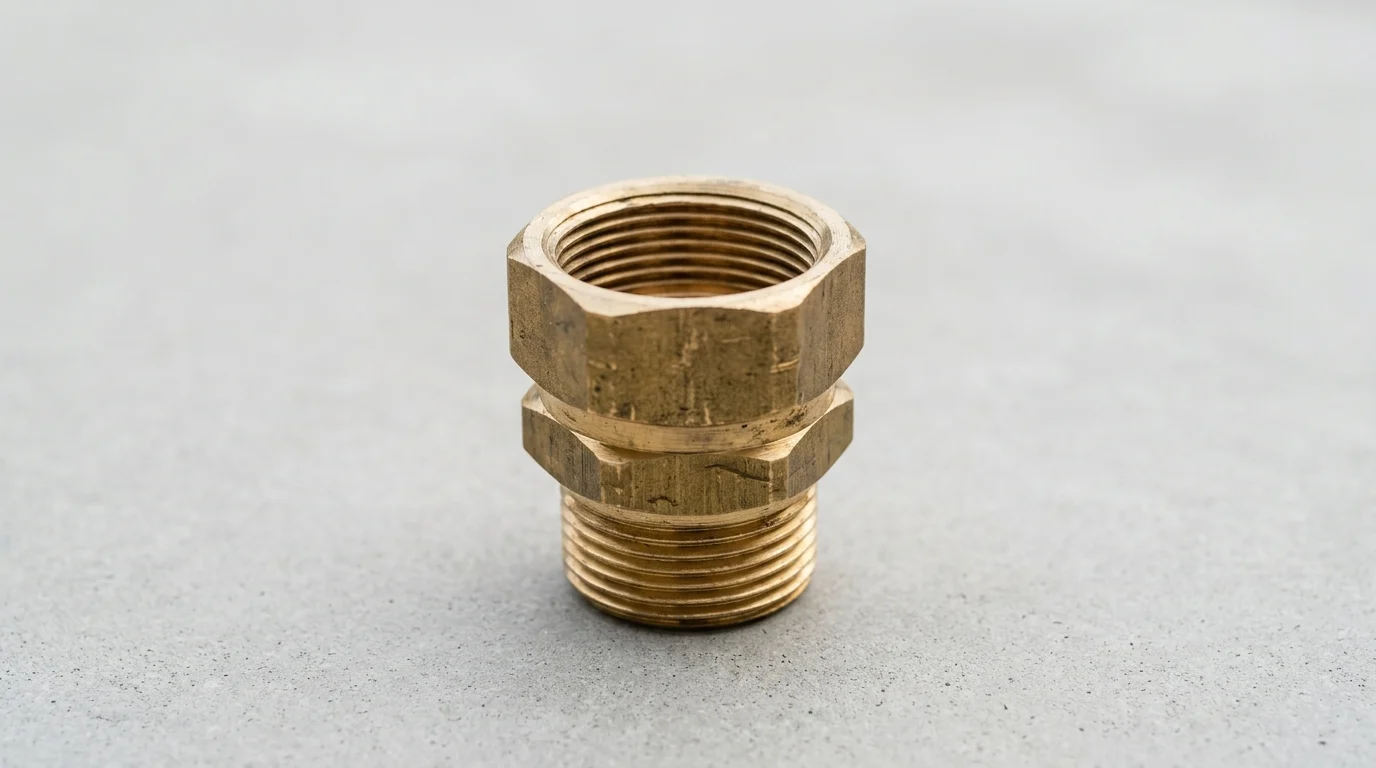
Choosing a male female pipe adapter is more than matching two threaded ends. The right fitting must accommodate thread standard, size, pressure rating, sealing method, material compatibility, and operating environment to keep a piping system safe and leak-free. This guide explains the main adapter types, common sizing conventions, and the industrial applications where correct selection matters most, from general fluid transfer to high-pressure and corrosive service. It also helps clarify how adapters bridge different connection standards and why small specification errors can lead to sealing failure, equipment damage, or unplanned downtime, setting up the key selection factors covered next.
Why the right male female pipe adapter matters
In industrial fluid handling, the structural integrity of a system relies heavily on the connections bridging disparate components. A male female pipe adapter serves as the critical junction connecting differing thread types, sizes, or genders within a piping network. Selecting the appropriate adapter extends beyond basic dimensional matching; it requires a rigorous evaluation of system pressures, fluid dynamics, and environmental exposures to prevent catastrophic failures and maintain operational continuity.
How adapter choice affects sealing and leaks
The primary function of any pipe adapter is to maintain a hermetic seal under varying operational loads. When engineers specify a male female pipe adapter, the choice directly dictates the sealing mechanism—whether through thread deformation in tapered designs or elastomeric seals in parallel threads. Mismatched thread pitches or incorrect taper angles compromise thread engagement and create immediate leak paths.
For instance, attempting to mate NPT with BSPT threads—which differ by a mere 1 degree in thread angle—can result in leakage rates exceeding 100 mL/min under moderate pressure. This mismatch also causes severe galling, which permanently damages both components and introduces metal particulate into the fluid stream.
Where male female pipe adapters are most critical
Certain industrial sectors demand zero-tolerance leakage protocols due to stringent safety and environmental regulations. In high-pressure hydraulics, chemical processing, and oil and gas instrumentation, the male female pipe adapter is frequently deployed to integrate sensitive analytical sensors with main process lines.
Instrumentation lines operating at 5,000 to 10,000 PSI require exact adapter tolerances to withstand cyclic pressure spikes and mechanical vibration. In these critical zones, an inferior or incorrectly specified adapter can lead to volatile fluid release, resulting in costly production downtime, equipment damage, and severe safety hazards for facility personnel.
Male female pipe adapter types, threads, and materials
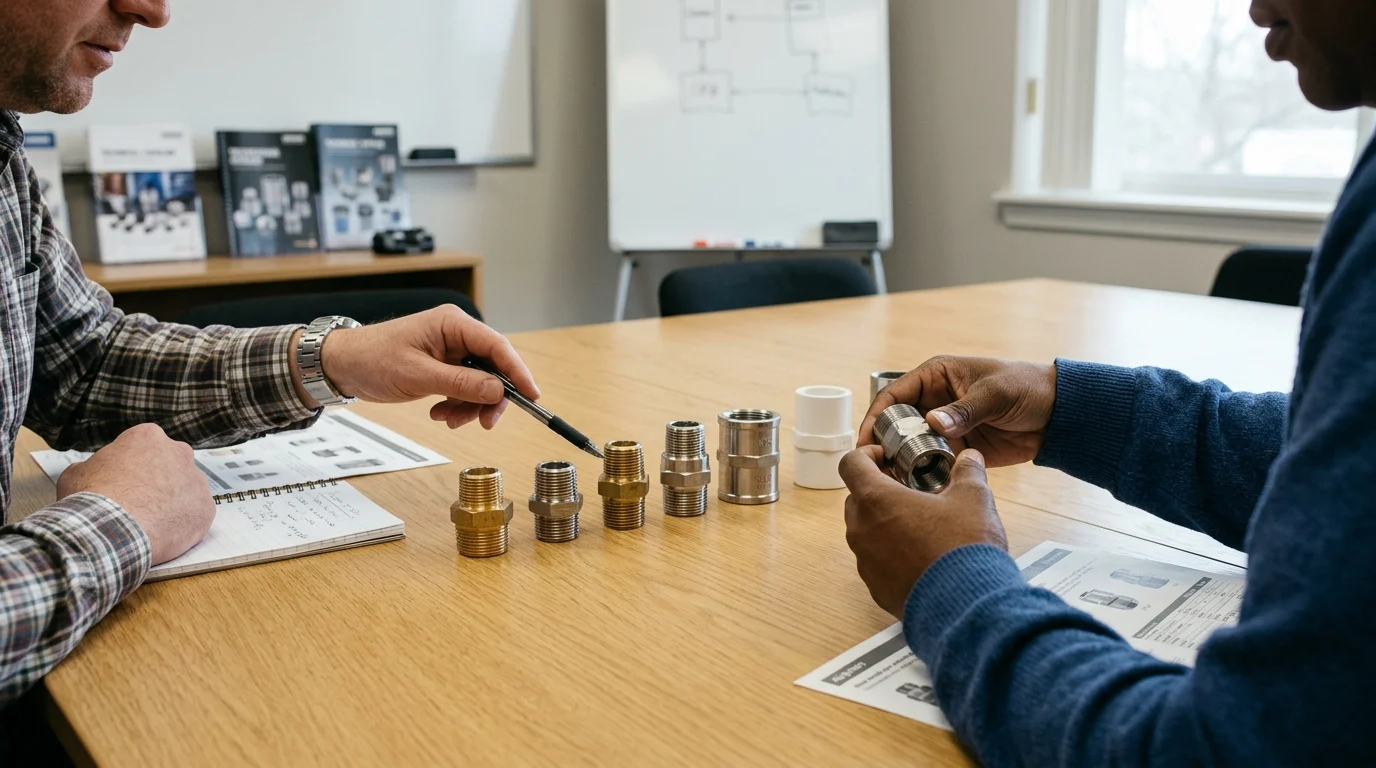
Industrial piping systems utilize a vast array of adapter configurations to accommodate complex routing and equipment integration. Understanding the structural variations, thread standards, and metallurgical properties of a male female pipe adapter is essential for ensuring long-term mechanical stability and broad chemical compatibility.
Common adapter configurations
Adapter configurations are engineered to solve specific spatial limitations and flow control challenges. The most prevalent configurations include straight reducers, expanders, elbows, and tees. A straight reducer male female pipe adapter is routinely used to step down flow diameter, with standard reduction ratios frequently spanning from 1/2-inch male to 1/4-inch female ports.
Angled adapters, such as 45-degree or 90-degree elbows, allow for directional changes in confined equipment housings without the need for additional pipe bending. This minimizes the installation footprint while actively reducing flow turbulence and subsequent pressure drops across the joint.
Thread standards and connection types
Thread standards dictate the mechanical interference and the required sealing methodology of the adapter. National Pipe Taper (NPT) and British Standard Pipe Taper (BSPT) rely on thread deformation and the application of PTFE tape or thread sealants to achieve a leak-tight joint. A standard NPT thread features a 60-degree thread angle, whereas BSPT utilizes a 55-degree angle.
Conversely, parallel threads like British Standard Pipe Parallel (BSPP) and Metric straight threads require an O-ring, bonded seal, or crush washer to prevent fluid bypass. Interchanging these standards without a dedicated conversion adapter compromises the structural integrity of the joint and guarantees eventual failure.
Material options and selection factors
Material selection dictates the adapter’s resistance to corrosion, temperature extremes, and mechanical stress. Common materials include brass, carbon steel, and various grades of stainless steel. For highly corrosive environments, 316L stainless steel offers superior pitting resistance, featuring a Pitting Resistance Equivalent Number (PREN) typically above 23.
Carbon steel adapters, while offering high tensile strength for hydraulic lines, require zinc plating or similar surface treatments to withstand atmospheric corrosion over time.
| Material | Max Operating Temperature | Typical Application | Relative Cost Index |
|---|---|---|---|
| Brass | 400°F (204°C) | Low-pressure water, compressed air | Low |
| Carbon Steel | 500°F (260°C) | High-pressure hydraulics, oil | Medium |
| 304 Stainless Steel | 1000°F (538°C) | General chemical processing | High |
| 316L Stainless Steel | 1200°F (649°C) | Marine, harsh chemical dosing | Very High |
How to match size, pressure, and media requirements
Accurate specification of a male female pipe adapter requires mapping system variables against component capabilities. Engineers must calculate precise dimensional tolerances, pressure thresholds, and media characteristics to prevent premature component failure and ensure safe fluid transport across all operating conditions.
Sizing basics and thread dimensions
Sizing a pipe adapter relies on nominal pipe size (NPS) rather than direct physical measurements, a distinction that frequently causes procurement errors. For example, a 1/4-inch NPT male female pipe adapter does not measure 0.25 inches across its threads; its actual outside diameter is 0.540 inches (13.716 mm).
Engineers must verify thread pitch—measured in threads per inch (TPI) or millimeter pitch—and ensure the thread engagement length adheres to standards such as ASME B1.20.1. Proper dimensional matching guarantees adequate mechanical grip and maximizes the effective sealing surface area.
Pressure, temperature, and chemical compatibility
Adapters must be rated to withstand the maximum system pressure, including transient spikes, alongside extreme temperature fluctuations. In hydraulic applications, a standard safety factor of 4:1 is typically applied. This dictates that an adapter rated for a working pressure of 3,000 PSI must possess a minimum burst pressure of 12,000 PSI.
Temperature variations directly impact pressure ratings; as temperatures elevate, the yield strength of the adapter material decreases, necessitating precise derating calculations. Furthermore, the chemical composition of the conveyed media dictates the required elastomeric seal material for parallel threads, with FKM (Viton) generally specified for high-temperature synthetic oils up to 400°F (204°C).
Using comparison tables for selection
Utilizing standardized comparison tables allows engineers to cross-reference thread types, sealing methodologies, and pressure limitations efficiently. These matrices streamline the specification process and reduce the risk of integrating incompatible mating components in multi-vendor systems.
| Thread Standard | Sealing Mechanism | Typical Max Pressure (1/4″ Size) | Primary Region of Use |
|---|---|---|---|
| NPT | Thread interference + sealant | 6,000 PSI | North America |
| BSPT | Thread interference + sealant | 6,000 PSI | Europe, Asia |
| BSPP | Elastomeric O-ring / Washer | 5,800 PSI | Global |
| SAE Straight Thread | O-ring Boss (ORB) | 6,000 PSI | North America |
Procurement, quality, and compliance checks
Securing reliable male female pipe adapters requires stringent supply chain management and rigorous quality control protocols. Industrial buyers must evaluate supplier capabilities, dimensional accuracy, and material traceability to mitigate the operational risks associated with substandard or counterfeit fittings.
How to verify dimensions and thread accuracy
Verifying the dimensional accuracy of a male female pipe adapter involves precise metrology and standardized testing. Manufacturers employ Go/No-Go thread plug and ring gauges to confirm pitch diameters, taper angles, and thread profiles before components leave the facility.
For high-pressure NPT fittings, thread flank angles must be held within a stringent ±30 minute tolerance. Any deviation beyond this threshold compromises the thread root and crest interference, creating microscopic spiral leak paths that PTFE sealants cannot reliably bridge under continuous pressure cycling.
Relevant standards and certifications
Compliance with international standards ensures global interoperability and baseline safety. Adapters should be manufactured in strict accordance with standards such as ASME B1.20.1 for NPT threads or ISO 7-1 for BSPT profiles.
Procurement teams should also mandate Material Test Reports (MTRs) to verify metallurgical composition. For instance, an MTR for a 316L stainless steel adapter must confirm a carbon content strictly below 0.03% to guarantee optimal weldability and resistance to intergranular corrosion. Supplier facilities should maintain active ISO 9001 certification to ensure consistent, repeatable manufacturing processes.
Inspection steps for supplier comparison
Establishing a robust inspection protocol facilitates accurate supplier comparisons and ensures batch consistency. Buyers should establish Acceptable Quality Limit (AQL) levels for incoming inventory, typically setting an AQL of 1.0 for critical dimensional tolerances and 2.5 for minor visual defects.
Surface finish represents another critical inspection parameter. The surface roughness (Ra) for high-purity fluid adapters should be maintained under 15 micro-inches (0.38 micrometers) to prevent particulate entrapment and bacterial growth. Evaluating suppliers based on their adherence to these quantitative metrics ensures the procurement of high-reliability components.
How to choose the best male female pipe adapter
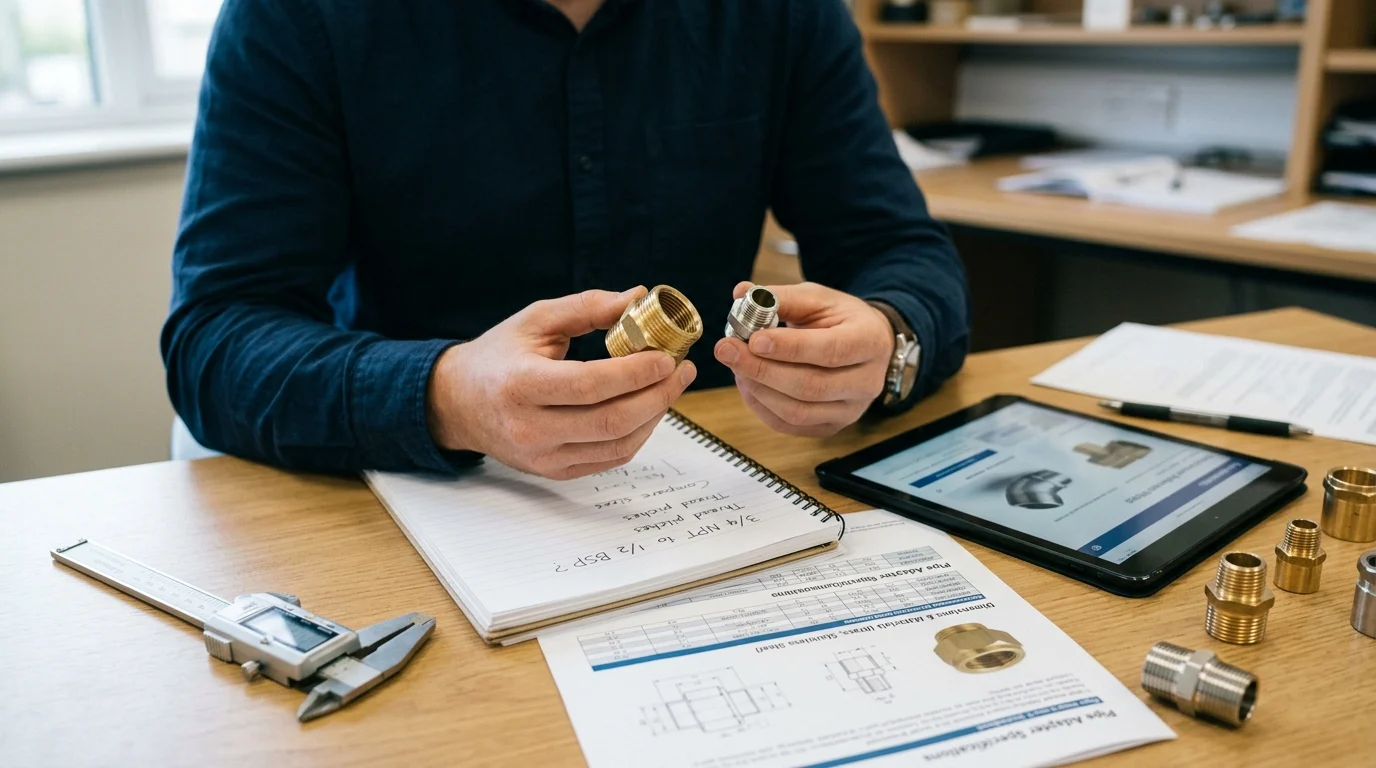
Finalizing the specification and procurement of a male female pipe adapter demands a balanced approach, weighing technical necessity against commercial viability. A structured selection process ensures that systems operate safely while optimizing supply chain logistics and lifecycle expenditures.
A practical selection framework
Employing a structured framework, such as the STAMP method (Size, Temperature, Application, Material, Pressure), standardizes the engineering decision-making process. Engineers must define the precise thread dimensions, calculate the derated pressure capacities at maximum operating temperatures, and evaluate the chemical compatibility of the material with the process media.
By assessing these variables collectively, buyers can accurately project lifecycle costs over a standard 5- to 10-year operational period. This analysis frequently reveals that a higher initial investment in a premium alloy adapter yields significant long-term savings through reduced maintenance cycles and the elimination of unplanned downtime.
When to use standard vs custom adapters
The decision between standard commercial off-the-shelf (COTS) components and custom-machined adapters hinges on application specificity and production volume. Standard adapters are highly cost-effective and readily available, often sourced in small batches of 50 to 100 units, making them ideal for routine maintenance and standard equipment integration.
Conversely, custom adapters become necessary when dealing with proprietary equipment ports, non-standard step-down ratios, or unique spatial constraints. However, custom manufacturing requires specialized CNC tooling and setup, typically imposing Minimum Order Quantities (MOQs) exceeding 1,000 units and extending procurement lead times by 6 to 8 weeks. Buyers must carefully justify the extended timelines and increased capital outlay of custom solutions against the specific operational benefits they provide.
Key Takeaways
- The most important conclusions and rationale for male female pipe adapter
- Specs, compliance, and risk checks worth validating before you commit
- Practical next steps and caveats readers can apply immediately
Frequently Asked Questions
What is a male female pipe adapter used for?
It connects components with different thread genders, sizes, or standards in one fluid system. It is commonly used in hydraulics, instrumentation, and chemical lines to create a secure, leak-resistant transition.
Can I connect NPT and BSPT threads directly?
No. NPT and BSPT differ in thread angle and sealing behavior. Use a dedicated conversion adapter to avoid leaks, thread damage, and poor pressure performance.
Which material is best for corrosive industrial media?
316L stainless steel is usually the safest choice for marine, chemical dosing, and other corrosive services. It offers better pitting resistance than brass, carbon steel, or 304 stainless in harsh environments.
How do I choose the right adapter size?
Match the male and female port sizes, thread standard, pressure rating, and sealing method. Check whether the system uses tapered threads with sealant or parallel threads with an O-ring or washer.
Where can I source industrial male female pipe adapters from nbfh-metal.com?
You can explore thread and stainless steel product resources on nbfh-metal.com, then confirm thread type, material grade, and working pressure with the supplier before ordering.
Post time: May-15-2026