

Introduction
Choosing pipe adapter fittings affects far more than whether two connections physically join. The right adapter must match thread standard, material, pressure class, temperature range, and sealing method to prevent leaks, corrosion, and premature failure in plumbing, hydraulic, and process systems. Small specification errors—such as mixing incompatible metals or confusing NPT with BSP threads—can create costly maintenance issues and safety risks. This article explains the main factors to evaluate when selecting pipe adapter fittings, highlights common mistakes, and helps you align fitting choice with system performance, reliability, and service conditions before moving into detailed specifications and application examples.
Why pipe adapter fittings matter
Pipe adapter fittings serve as the critical junctions within industrial and commercial fluid conveyance systems, bridging disparate piping architectures. Whether joining metric to imperial dimensions, transitioning from metal to polymer, or adapting National Pipe Thread (NPT) to British Standard Pipe (BSP), these components dictate the structural integrity of the entire network.
Selecting the correct adapter is not merely a matter of dimensional matching. Engineers must evaluate metallurgical compatibility, pressure ratings, and sealing mechanisms to ensure continuous, safe operation across diverse media.
Impact on reliability and maintenance
The reliability of fluid systems hinges heavily on the performance of their smallest components. A compromised adapter fitting introduces vulnerabilities that cascade throughout the facility, resulting in severe operational disruptions. In high-pressure hydraulic or chemical processing environments, unplanned downtime costs can easily exceed $10,000 per hour.
Furthermore, even minor leaks carry substantial financial and environmental penalties. A single adapter leaking at a rate of just one drop per second equates to a loss of approximately 3,000 gallons of fluid per year, which is particularly costly when dealing with specialized coolants, hydraulic oils, or hazardous chemicals.
Common specification errors
Procurement teams and system designers frequently encounter pitfalls when specifying adapters. A prevalent error is forcing a connection between incompatible thread standards, such as attempting to mate an NPT male thread with a BSPP (parallel) female port. While the threads may partially engage, the mismatch in thread angle and pitch inevitably leads to spiral leakage and thread galling.
Another common oversight is improper installation torque. Industry data indicates that up to 60% of premature fitting failures result from improper thread engagement or over-tightening. For standard tapered threads, exceeding the recommended 1.5 to 3 turns past finger-tight can deform the fitting body, compromise the pressure seal, and initiate stress-corrosion cracking.
Core specifications to verify
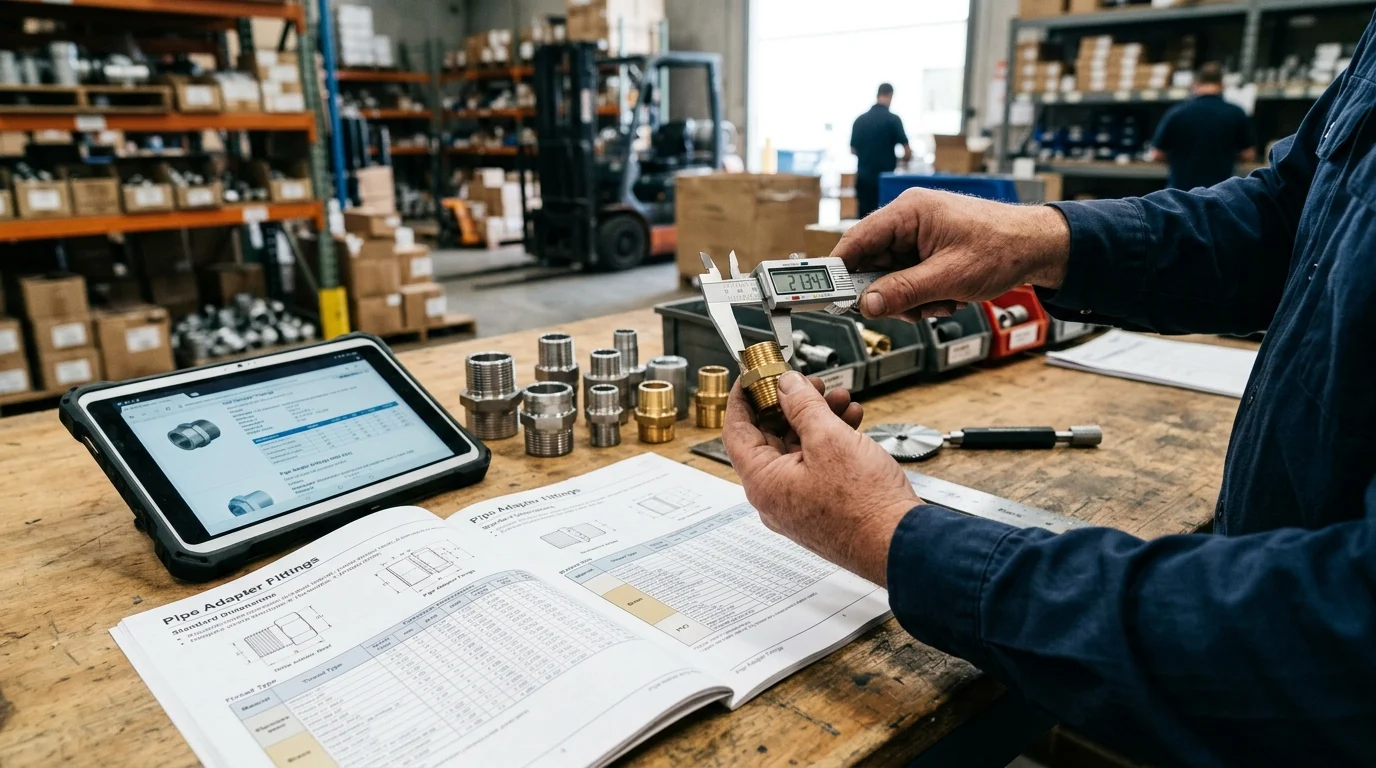
Accurate specification of pipe adapter fittings requires a rigorous assessment of the operational environment. Engineers must align the fitting’s physical and mechanical properties with the precise demands of the fluid system to prevent catastrophic blowouts or rapid degradation.
Material, pressure, and temperature compatibility
Material selection dictates the adapter’s resistance to chemical attack and its structural stability under extreme conditions. For instance, 316 Stainless Steel is highly favored in aggressive environments, capable of handling operating pressures up to 10,000 psi and temperatures reaching 1,000°F (537°C).
Conversely, polymer fittings offer excellent resistance to certain corrosives but have strict thermal limitations. Standard Polyvinyl Chloride (PVC) adapters are generally limited to a maximum operating temperature of 140°F (60°C) and require a significant pressure rating reduction when ambient temperatures exceed 73°F (23°C).
Thread type, end connection, size, and tolerance
Identifying the correct thread type and end connection is paramount for achieving a leak-free seal. Fluid systems utilize a myriad of standards, including NPT, BSPT, SAE straight threads with O-rings, and JIC 37-degree flares. Each standard specifies unique thread pitches, flank angles, and sealing methods.
Dimensional tolerance also plays a critical role in fitting performance. High-quality adapters are machined to strict tolerances, such as Class 2A/2B for unified threads, ensuring adequate engagement without excessive play. Specifying the exact nominal size and verifying the tolerance class prevents cross-threading during assembly.
Metal vs plastic fitting comparison
The choice between metallic and polymeric adapters fundamentally alters the system’s performance envelope. Metals provide superior tensile strength and impact resistance, making them mandatory for high-vibration and high-pressure zones. Plastics offer immunity to galvanic corrosion and are highly cost-effective for low-pressure water or chemical distribution.
| Material | Max Temperature | Max Pressure (Typical 1″ Size) | Primary Application |
|---|---|---|---|
| 316 Stainless Steel | 1,000°F (537°C) | 6,000 – 10,000 psi | High-pressure hydraulics, harsh chemicals |
| Brass | 400°F (204°C) | 3,000 psi | Pneumatics, potable water, HVAC |
| CPVC | 200°F (93°C) | 400 psi (at 73°F) | Hot water distribution, corrosive drains |
| Standard PVC | 140°F (60°C) | 450 psi (at 73°F) | Cold water irrigation, low-pressure chemicals |
When transitioning between metal and plastic lines, engineers must exercise caution. Threading a metal male adapter into a plastic female port is generally discouraged, as the rigid metal can easily split the plastic female threads under radial stress. Instead, utilizing a plastic male threaded adapter into a metal female port is the recommended best practice.
Codes, quality, and application risks
Navigating the complex landscape of industrial regulations and environmental stressors is essential for mitigating application risks. Adapters must not only perform under steady-state conditions but also survive transient spikes and comply with stringent legal frameworks.
Standards, certifications, and regional codes
Compliance with recognized standards guarantees interoperability and safety. Thread dimensions must adhere to specifications like ASME B1.20.1 for NPT or ISO 228 for parallel threads. In critical sectors such as food and beverage or municipal water supply, material certifications are legally mandated.
For example, the NSF/ANSI 61 standard governs water treatment and distribution products in North America. Following recent regulatory updates, this standard mandates a weighted average lead content of less than 0.25% for all wetted surfaces in potable water systems. Utilizing non-compliant brass adapters in these networks exposes organizations to severe legal liabilities and forced system overhauls.
Corrosion, vibration, thermal cycling, and chemical exposure
Industrial environments subject adapter fittings to a barrage of physical and chemical stressors. Thermal cycling—the repeated expansion and contraction due to temperature fluctuations—can back-off threaded connections over time. In high-vibration applications, such as heavy machinery or pump discharges, rigid adapters may suffer fatigue failure, necessitating the use of elastomeric seals or flared connections.
Galvanic corrosion represents a silent but destructive risk when joining dissimilar metals. When an electrolyte is present, the less noble metal acts as an anode and corrodes rapidly. To prevent severe bimetallic degradation, engineers must keep the galvanic potential difference between connected materials below 0.15V in harsh, moisture-rich environments, and below 0.25V in controlled, normal environments. Using dielectric unions or specialized isolating adapters mitigates this risk.
Sourcing and procurement factors
Strategic sourcing of pipe adapter fittings goes beyond comparing unit prices. Procurement professionals must evaluate vendor reliability, quality assurance protocols, and the total cost of ownership to build a resilient supply chain.
Comparing manufacturers and suppliers
Evaluating manufacturers requires a deep dive into their quality management systems. Suppliers should maintain active ISO 9001 certifications and provide full lot traceability from raw material ingots to the finished machined part.
For critical fluid systems, procurement teams should target suppliers capable of maintaining defect rates below 500 PPM (parts per million). High-tier manufacturers utilize automated optical inspection and CNC multi-axis machining to guarantee thread concentricity and surface finish, drastically reducing the likelihood of out-of-box failures.
Hidden cost drivers
The initial purchase price of an adapter fitting represents a fraction of its total lifecycle cost. Hidden cost drivers heavily influence the procurement equation. Expedited shipping fees for emergency replacements and high Minimum Order Quantities (MOQs)—which often range from 100 to 1,000 units for custom machined adapters—can inflate project budgets.
Furthermore, the cost of failure dwarfs the component cost. Maintenance labor, system draining, and operational downtime account for 80-90% of the true cost of replacing a failed $10 adapter. Investing in higher-quality, slightly more expensive fittings upfront yields substantial dividends in reduced maintenance overhead.
Qualification process for new fittings
Introducing a new fitting or transitioning to a different supplier necessitates a formal qualification process. This protocol typically begins with a First Article Inspection (FAI) to verify dimensional accuracy against engineering drawings. Subsequent steps include burst pressure testing, salt spray corrosion testing, and the review of Material Test Reports (MTRs).
| Evaluation Criteria | Importance Weight | Minimum Acceptable Threshold |
|---|---|---|
| Dimensional Accuracy | High | 100% compliance with ASME/ISO standards |
| Material Traceability | High | Full MTR availability per batch |
| Defect Rate History | Medium | < 500 PPM over the last 12 months |
| Delivery Lead Time | Medium | Under 4 weeks for standard catalog items |
By standardizing this qualification matrix, organizations ensure that any new adapter fitting integrated into the facility meets strict performance baselines before bulk procurement is authorized.
Selection workflow and final decision criteria

Finalizing the choice of pipe adapter fittings requires a structured, repeatable workflow. By standardizing the decision-making process, engineering and procurement teams can eliminate guesswork, streamline inventory, and ensure consistent system performance.
Step-by-step fitting selection workflow
A widely adopted methodology for specifying fluid components is the STAMPED framework, which stands for Size, Temperature, Application, Media, Pressure, Ends, and Delivery. Engineers progress through each variable systematically. First, the inner diameter and flow requirements dictate the Size. Next, Temperature and Media determine the necessary material and seal elastomers.
Pressure ratings require careful calculation. It is an industry standard to apply a safety factor of 4:1 for pressure ratings in dynamic hydraulic applications. If the system experiences a maximum working pressure of 3,000 psi, the adapter fitting must be rated for a minimum burst pressure of 12,000 psi. Finally, Ends (thread types) and Delivery (logistics) close out the specification workflow.
Criteria for standardization and inventory planning
Proliferation of fitting SKUs creates inventory bloat and increases the risk of technicians installing incorrect parts. Organizations should establish strict criteria for standardization, prioritizing dual-certified or multi-purpose adapters where feasible. For example, standardizing on 316 Stainless Steel for both low-corrosion and high-corrosion lines might marginally increase unit costs but drastically simplifies inventory management.
Consolidation yields measurable financial benefits. Reducing the number of active fitting SKUs by 15-20% can lower annual carrying costs by thousands of dollars, assuming a standard 20% inventory carrying cost rate. By implementing a standardized fitting catalog, facilities optimize their storeroom footprint and accelerate maintenance response times.
Key Takeaways
- The most important conclusions and rationale for pipe adapter fittings
- Specs, compliance, and risk checks worth validating before you commit
- Practical next steps and caveats readers can apply immediately
Frequently Asked Questions
How do I choose the right thread type for a pipe adapter fitting?
Match the exact standard and seal method: NPT, BSPT, BSPP, JIC, or SAE O-ring. Do not force similar-looking threads; verify pitch, angle, and port style first.
When should I use stainless steel instead of brass or plastic adapters?
Use 316 stainless for corrosive media, high pressure, high heat, or vibration. Brass suits water, air, and HVAC. PVC or CPVC works for lower-pressure, corrosion-resistant applications within temperature limits.
Can I connect metal pipe to plastic pipe with an adapter fitting?
Yes, but confirm pressure, temperature, and chemical compatibility on both sides. Avoid over-tightening plastic threads, and use the correct transition fitting to reduce cracking and leaks.
What installation mistake causes the most adapter fitting leaks?
Wrong thread pairing and over-tightening are the most common causes. Follow the fitting’s torque guidance and sealing method instead of adding force to make mismatched threads fit.
Can nbfh-metal.com help with custom pipe adapter fittings?
Yes, if you need specific materials, thread combinations, or tolerances, contact nbfh-metal.com with your size, pressure, temperature, and media details for a targeted recommendation.
Post time: May-17-2026