
Introduction
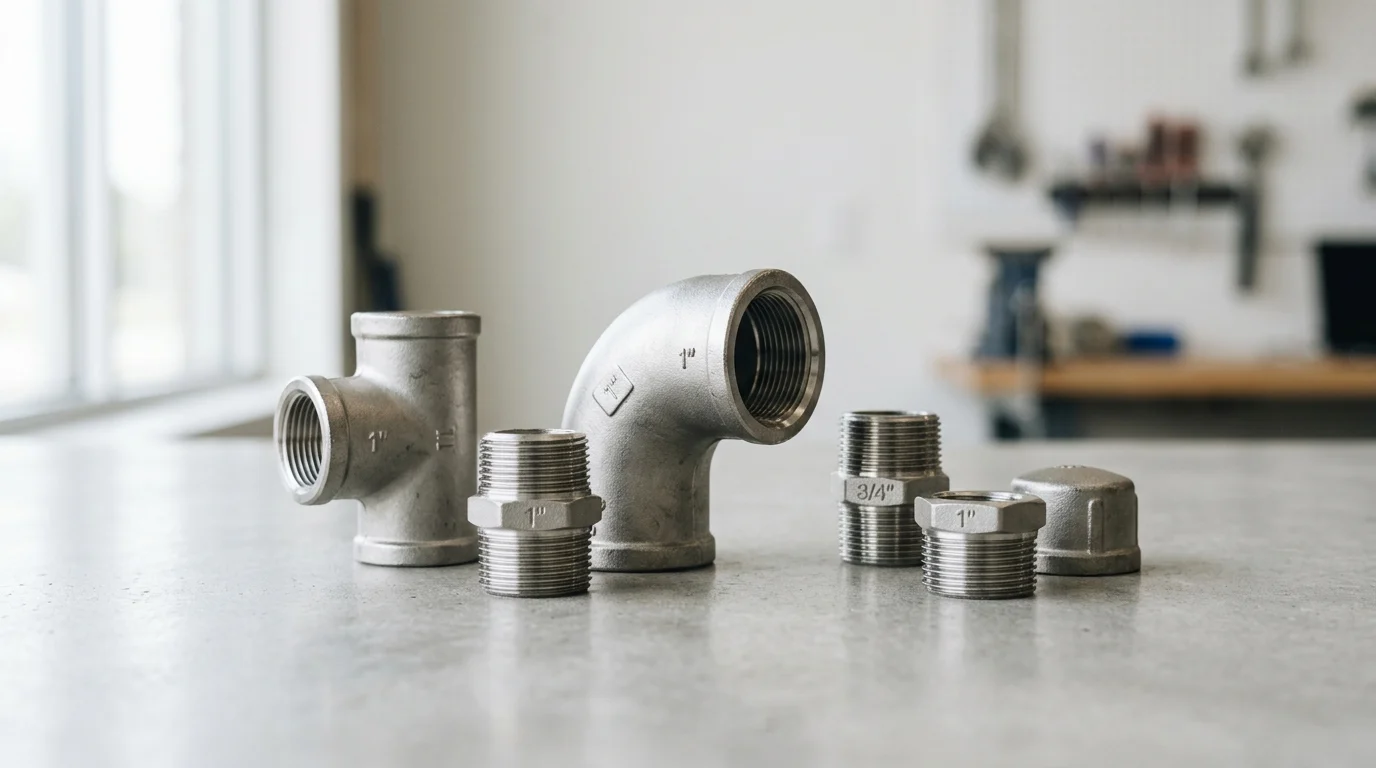
Pipe fittings often determine whether a piping system remains reliable under pressure, temperature swings, and corrosive conditions. Stainless steel fittings are widely used because they combine mechanical strength with long-term resistance to oxidation, chemicals, and hygiene-related contamination. This article explains the main fitting types, where they are commonly used, and why material selection matters in industrial, commercial, and sanitary applications. It also highlights practical benefits such as leak prevention, durability, cleanability, and reduced maintenance, helping readers understand how the right fitting supports safer and more efficient fluid handling systems.
Why stainless steel pipe fittings matter in industrial systems
In any industrial fluid handling system, the straight runs of pipe rarely cause the most headaches. The real vulnerabilities lie at the joints, turns, and branches. Stainless steel pipe fittings serve as the critical connective tissue in these systems, holding everything together while managing fluid flow, pressure changes, and structural stress. When dealing with aggressive chemicals, extreme temperatures, or high-purity requirements, standard carbon steel or plastic simply will not cut it.
Engineers and system designers lean heavily on stainless steel because of its predictable performance envelope. Whether a system operates at a standard 150 PSI or pushes past 6,000 PSI in a high-pressure hydraulic line, the right stainless fitting ensures the system remains sealed and safe. Understanding how these components function at a granular level is the first step to building piping infrastructure that lasts decades rather than months.
Impact on corrosion risk
The primary reason stainless steel is specified over cheaper alternatives is its inherent resistance to oxidation and chemical attack. This resistance comes from a microscopic, self-healing chromium oxide layer (typically 1 to 3 nanometers thick) that forms on the surface of the metal. As long as there is oxygen present, this passive layer regenerates if scratched or machined.
However, corrosion risk is rarely zero. In industrial environments, localized attacks like pitting or crevice corrosion are constant threats, especially in chloride-rich environments. For baseline protection in benign environments, standard stainless alloys experience a corrosion rate of less than 0.002 inches per year. But when dealing with brackish water or chemical processing, engineers often look at the Pitting Resistance Equivalent Number (PREN). A PREN of over 23 is generally required to mitigate corrosion risks in basic marine or high-chloride applications, dictating the specific alloy grade needed for the fittings.
Industries that rely on them
Different sectors demand stainless steel fittings for entirely different reasons. In the food, beverage, and pharmaceutical industries, hygiene is the driving factor. These facilities require sanitary fittings with polished internal surface finishes—often specified with a roughness average (Ra) of less than 0.8 micrometers—to prevent bacterial growth and allow for Clean-in-Place (CIP) processes.
Conversely, the petrochemical, oil and gas, and power generation sectors rely on stainless steel for its mechanical strength at extreme temperatures. A refinery might use heavy-wall (Schedule 160) stainless fittings to handle hydrocarbon processing at 800°F and pressures exceeding 3,000 PSI, while a cryogenic LNG facility relies on the same material because stainless steel retains its toughness (typically maintaining impact energy above 40 Joules) and does not become brittle at -320°F. Water treatment and desalination plants also consume massive volumes of these fittings to combat the aggressive nature of reverse osmosis processes, which often operate between 800 and 1,200 PSI.
Types of stainless steel pipe fittings
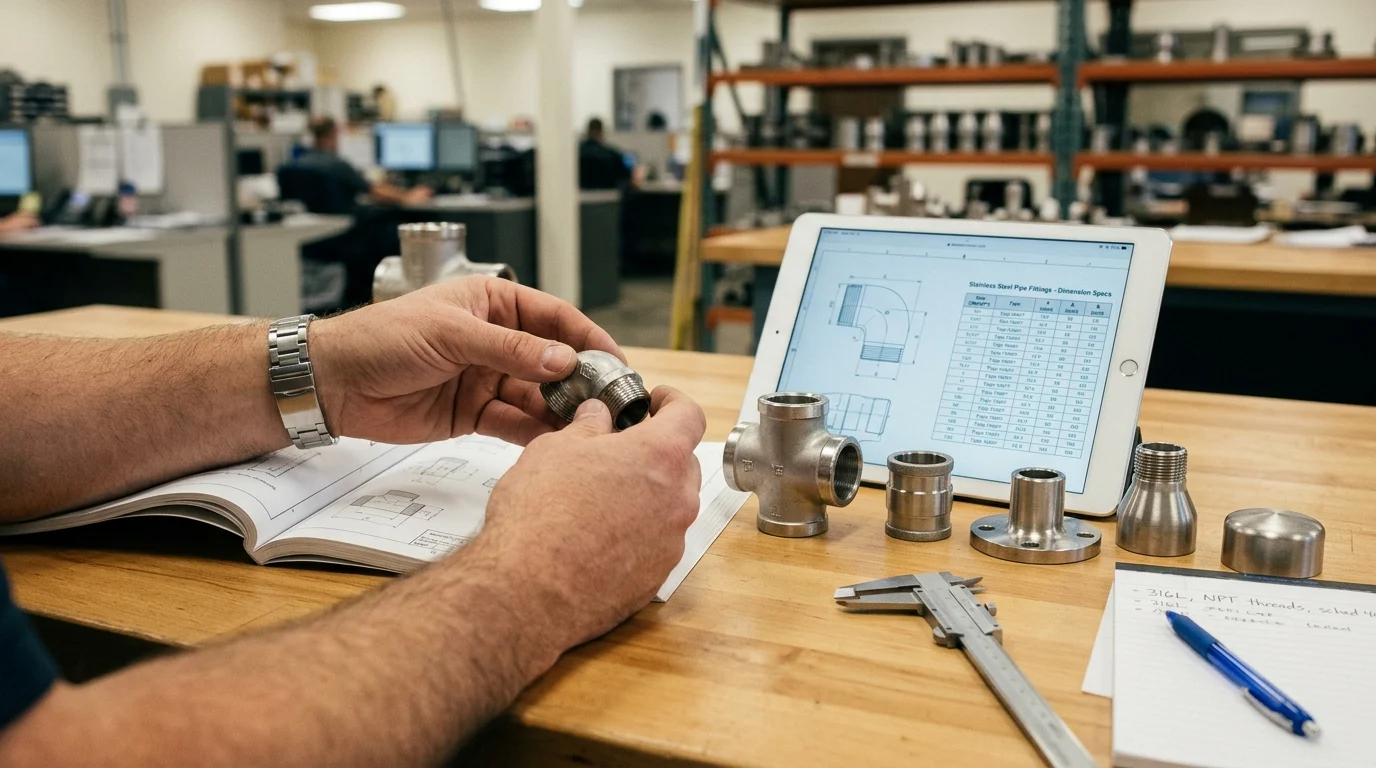
Stainless steel pipe fittings are not a one-size-fits-all commodity. They are highly specialized components engineered to perform specific geometric and mechanical functions within a piping system. Sizing can range anywhere from tiny 1/8-inch instrumentation fittings up to massive 24-inch or larger components used in heavy industrial mains.
Categorizing these fittings usually comes down to two main factors: what the fitting physically does to the fluid flow, and how it attaches to the adjacent piping. Mixing up the wrong connection type or geometry can lead to flow restrictions, pressure drops, or catastrophic leaks.
Fittings for direction change, branching, and reduction
Fittings that change direction, branch off, or alter the pipe size make up the bulk of any piping inventory. Elbows are the most common, typically available in 45-degree and 90-degree angles, allowing pipelines to navigate around structural obstacles. Long radius elbows (where the centerline radius is 1.5 times the nominal pipe size) are often preferred to minimize frictional pressure drops, while short radius elbows (1.0 times the nominal pipe size) are used in tight spatial constraints.
When a line needs to split or combine, tees and crosses are utilized. Tees provide a 90-degree branch from the main run, and crosses allow for four-way intersections, though they are less common due to the complex stress points they create. Finally, reducers transition the piping from a larger diameter to a smaller one. Concentric reducers are symmetrical and used in vertical runs, while eccentric reducers have one flat side, making them ideal for horizontal runs to prevent air or gas pockets from forming at the top of the pipe.
Threaded, socket weld, butt weld, and compression connections
The method used to join the fitting to the pipe is just as critical as the fitting’s shape. Threaded connections, usually featuring National Pipe Thread (NPT), are common for smaller pipe sizes (typically 2 inches and under). They are easy to install and dismantle but are prone to leaks in high-vibration or high-temperature cycling environments.
Socket weld fittings involve inserting the pipe into a recessed area of the fitting and applying a fillet weld around the exterior. This provides a stronger, leak-proof joint compared to threads, often used in lines up to 4 inches. Butt weld fittings, on the other hand, require the pipe and fitting to be precisely beveled (typically at a 37.5-degree angle) and welded end-to-end. This is the gold standard for high-pressure, large-diameter piping (Schedule 10 through 160) because it offers the smoothest internal flow and the highest structural integrity.
Compression fittings use a ferrule system that bites into the tubing when a nut is tightened. These are almost exclusively used for thin-wall instrumentation lines, typically 1 inch or smaller, allowing for rapid assembly without the need for welding equipment.
Pressure capability and cleanability comparison
Choosing between these types requires balancing pressure requirements against maintenance and cleanability needs. A threaded joint might be cheap and easy, but the microscopic gaps in the threads are notorious traps for bacteria and corrosive media.
| Connection Type | Typical Size Range | Max Pressure Class | Cleanability / Hygiene |
|---|---|---|---|
| Threaded (NPT) | 1/8″ to 4″ | Up to 6,000 PSI | Poor (Thread gaps trap media) |
| Socket Weld | 1/8″ to 4″ | Up to 9,000 PSI | Fair (Internal crevice exists) |
| Butt Weld | 1/2″ to 24″+ | Matches Pipe Sch. | Excellent (Smooth internal bore) |
| Sanitary Clamp | 1/2″ to 8″ | ~300 PSI | Superior (Designed for CIP/SIP) |
As the table shows, high-pressure industrial systems lean heavily toward socket and butt welds, while sanitary applications sacrifice high-pressure capabilities for the superior cleanability of specialized clamp fittings.
How to evaluate stainless steel pipe fittings
Evaluating stainless steel pipe fittings requires looking past the shiny exterior and digging into the metallurgical and dimensional specifications. A fitting might look perfect on the shelf, but if its schedule, alloy, or pressure class does not align with the system’s demands, it becomes an immediate liability.
Engineers and procurement teams must cross-reference material properties against the expected operating environment to ensure safety and longevity. This means paying close attention to grade differences, manufacturing standards, and the paperwork that proves the fitting is exactly what the manufacturer claims it is.
Choosing 304 vs 316 stainless steel
The debate between 304 and 316 stainless steel is the most common material decision in piping design. Grade 304 contains roughly 18% chromium and 8% nickel, making it an excellent baseline workhorse for freshwater, indoor infrastructure, and mild chemical environments.
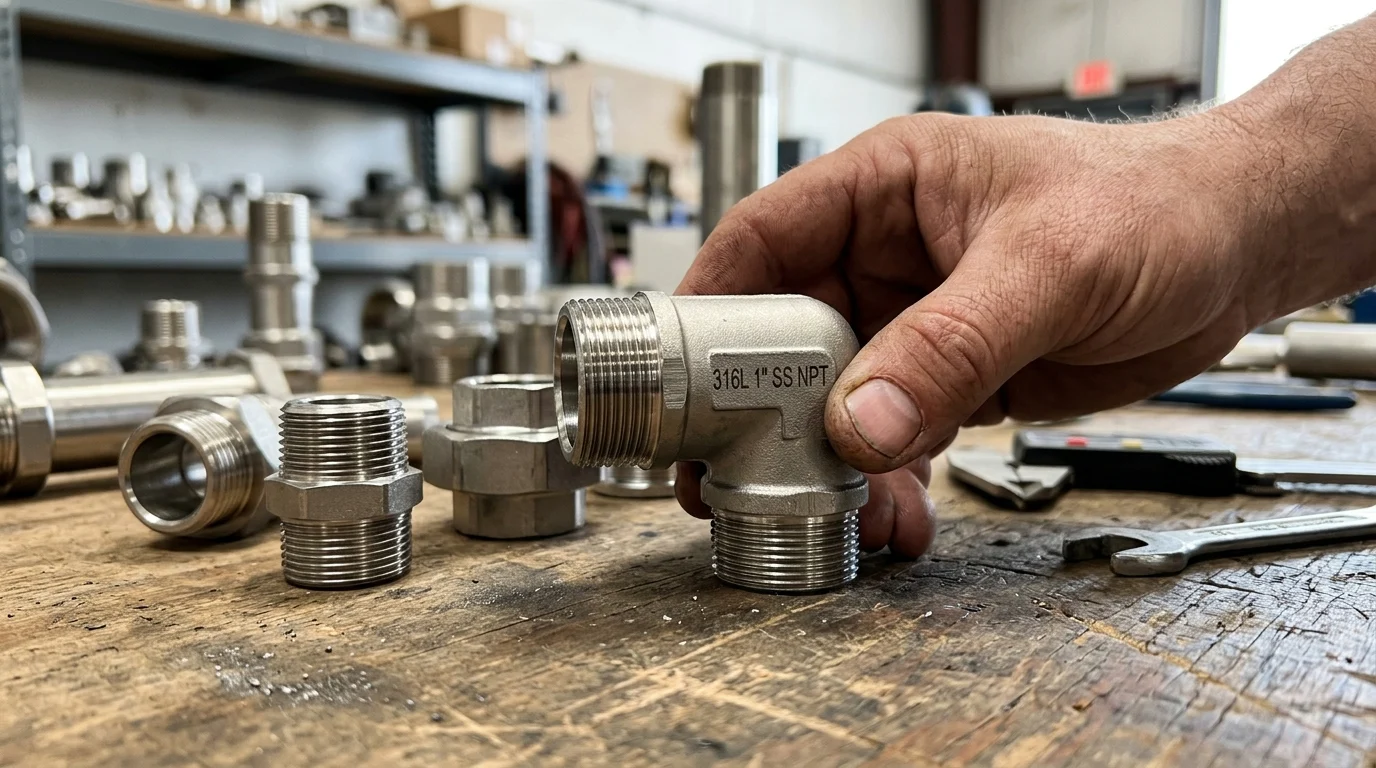
Grade 316 takes that baseline and adds 2% to 3% molybdenum. That small addition drastically increases the metal’s resistance to chlorides and industrial solvents. If a pipeline runs near the coast, handles de-icing salts, or carries aggressive chemicals, 316 is the standard choice. Because of the added molybdenum and nickel, 316 fittings generally cost 20% to 30% more than their 304 counterparts. Specifying the “L” variant (like 316L) is also crucial for welded fittings, as the lower carbon content (maximum 0.03%) prevents carbide precipitation during welding, maintaining corrosion resistance at the joints.
| Alloy Grade | Chromium (%) | Nickel (%) | Molybdenum (%) | Max Carbon (%) | Typical PREN | Relative Cost |
|---|---|---|---|---|---|---|
| 304 | 18.0 – 20.0 | 8.0 – 10.5 | N/A | 0.08 | ~18 – 20 | Baseline (1.0x) |
| 316 | 16.0 – 18.0 | 10.0 – 14.0 | 2.0 – 3.0 | 0.08 | ~23 – 28 | 1.2x – 1.3x |
| 316L | 16.0 – 18.0 | 10.0 – 14.0 | 2.0 – 3.0 | 0.03 | ~23 – 28 | 1.25x – 1.35x |
Dimensions, schedules, pressure classes, and standards
Fittings are governed by strict dimensional and pressure standards to ensure global interchangeability. Butt weld fittings usually conform to ASME B16.9, which dictates the overall dimensions, tolerances, and wall thicknesses. The wall thickness is denoted by the pipe “Schedule”—common sizes include Schedule 10 (thin wall, e.g., 0.109 inches for a 2-inch pipe), Schedule 40 (standard, 0.237 inches), and Schedule 80 (extra heavy, 0.343 inches). The fitting’s schedule must exactly match the adjoining pipe to prevent turbulent flow and weak points.
Forged fittings, which include threaded and socket weld types, fall under the ASME B16.11 standard. Instead of schedules, these are rated by pressure classes: 3000#, 6000#, and 9000#. A 3000# fitting is generally paired with Schedule 80 pipe, while a 6000# fitting pairs with Schedule 160. Using mismatched classes and schedules is a fast track to a blown joint.
Temperature, media chemistry, surface finish, and traceability
Even the right alloy and schedule can fail if secondary factors are ignored. Temperature significantly derates the pressure capacity of stainless steel. For instance, a 316 stainless fitting loses approximately 20% of its allowable stress capacity when operating at 400°F compared to room temperature, and nearly 40% at 800°F. The chemistry of the media also dictates the required surface finish; standard industrial finishes typically range from Ra 3.2 to 6.3 µm, whereas rougher surfaces invite scale buildup and localized corrosion.
Finally, traceability is non-negotiable in critical applications. Every quality fitting should come with a Material Test Report (MTR) conforming to EN 10204 3.1. This document traces the exact heat lot of the steel, providing the actual chemical composition and mechanical test results from the mill. Without an MTR, a fitting is essentially unidentified scrap metal in the eyes of industrial inspectors.
How to source quality stainless steel pipe fittings
Sourcing stainless steel pipe fittings has become increasingly complex in a globalized market. The visual difference between a high-quality, fully compliant fitting and a substandard counterfeit is often imperceptible to the naked eye. Relying solely on the lowest bidder is a dangerous strategy when process integrity is on the line.
Developing a robust sourcing protocol means scrutinizing the entire supply chain, from the mill that poured the raw steel to the distributor that stocks the finished elbows and tees. A proactive approach to sourcing prevents costly project delays and catastrophic field failures.
Qualifying manufacturers, mills, and distributors
The first step in secure sourcing is establishing an Approved Manufacturer List (AML). Reputable buyers will only accept fittings from manufacturers that maintain active ISO 9001 certifications and have a proven track record in the specific industry. It is important to distinguish between mills (which produce the raw pipe or billet) and the fitting manufacturers (which forge, bend, and machine the final product).
Distributors also play a vital role. A tier-one distributor will audit their manufacturing partners regularly and maintain strict quarantine procedures for non-conforming materials. When sourcing, ask distributors about their vendor qualification processes; if they buy from the open spot market without vetting the origin, the risk of receiving mixed or substandard alloys skyrockets.
Inspection, documentation, and testing checks
Trusting the paperwork is good, but verifying the physical product is better.
How to choose the right stainless steel pipe fittings
Key Takeaways
- The most important conclusions and rationale for stainless steel pipe fittings
- Specs, compliance, and risk checks worth validating before you commit
- Practical next steps and caveats readers can apply immediately
Frequently Asked Questions
What are stainless steel pipe fittings used for?
They connect, redirect, branch, or reduce piping in fluid handling systems while helping maintain pressure, sealing, corrosion resistance, and system safety.
Which stainless steel fitting types are most common?
Common types include elbows, tees, reducers, crosses, couplings, unions, caps, plugs, flanges, and threaded or welded fittings.
How do I choose the right stainless steel pipe fitting?
Match the fitting to pipe size, pressure rating, temperature, fluid type, corrosion risk, connection method, and applicable industry standards.
Are stainless steel fittings suitable for high-pressure systems?
Yes, when properly specified. High-pressure systems may require heavy-wall fittings, correct alloy grades, and verified ratings for the operating pressure.
When should 316 stainless steel fittings be used?
Use 316 stainless steel for chloride-rich, marine, chemical, or harsh environments where better pitting and corrosion resistance is needed than 304.

Daniel Carter
Post time: Apr-24-2026