
Introduction
Across manufacturing, food processing, pharmaceuticals, and mobile equipment, connection points are becoming a measurable source of delay, labor cost, and leakage risk. Quick connect hose fittings are gaining ground because they shorten changeovers, simplify maintenance, and improve operator safety without sacrificing flow control or system reliability. For engineers, buyers, and plant managers, the shift is less about convenience than about throughput, compliance, and total operating cost. This article explains why traditional threaded connectors are losing favor, where quick connects deliver the biggest operational advantage, and what makes them a practical upgrade in modern industrial systems.
Why are quick connect hose fittings a strategic priority
The industrial landscape is aggressively shifting away from hard-plumbed and threaded connections in favor of quick connect hose fittings. This transition is not merely a matter of convenience; it represents a strategic realignment toward process optimization and operational agility. Facility managers and system engineers increasingly view fluid and pneumatic transfer points as critical nodes where efficiency gains directly impact the bottom line.
How do downtime, labor efficiency, and safety pressures drive adoption
Modern manufacturing and processing environments operate under stringent equipment effectiveness targets, making downtime a primary enemy of profitability. Traditional threaded fittings often require wrenches, thread sealant, and three to five minutes of labor per connection point. In contrast, quick connect hose fittings reduce this engagement time to under 10 seconds per coupling. This rapid changeover capability is crucial for multi-product assembly lines and batch processing facilities.
Beyond labor efficiency, safety pressures heavily influence procurement decisions. Repetitive strain injuries (RSIs) are a known risk when operators must manually torque dozens of threaded connections daily. Quick connects equipped with ergonomic push-to-connect mechanisms eliminate this physical strain. Furthermore, specialized non-spill valving prevents hazardous chemical exposure and slip hazards, directly addressing OSHA compliance and workplace safety mandates.
Which industries are replacing traditional connectors first
Several sectors are spearheading the mass adoption of quick connect hose fittings due to their unique operational constraints. The food and beverage industry relies heavily on these components for clean-in-place (CIP) processes, where hoses must be routinely disconnected for sanitation without risking bacterial harbor points.
Similarly, the rapidly expanding data center sector utilizes non-spill quick disconnects for liquid cooling systems, where a coolant leak could cause catastrophic hardware failure. In chemical processing and pharmaceutical manufacturing, high-alloy quick connects are standard practice to manage aggressive solvents while ensuring environmental containment and operator safety.
What are quick connect hose fittings and how do they
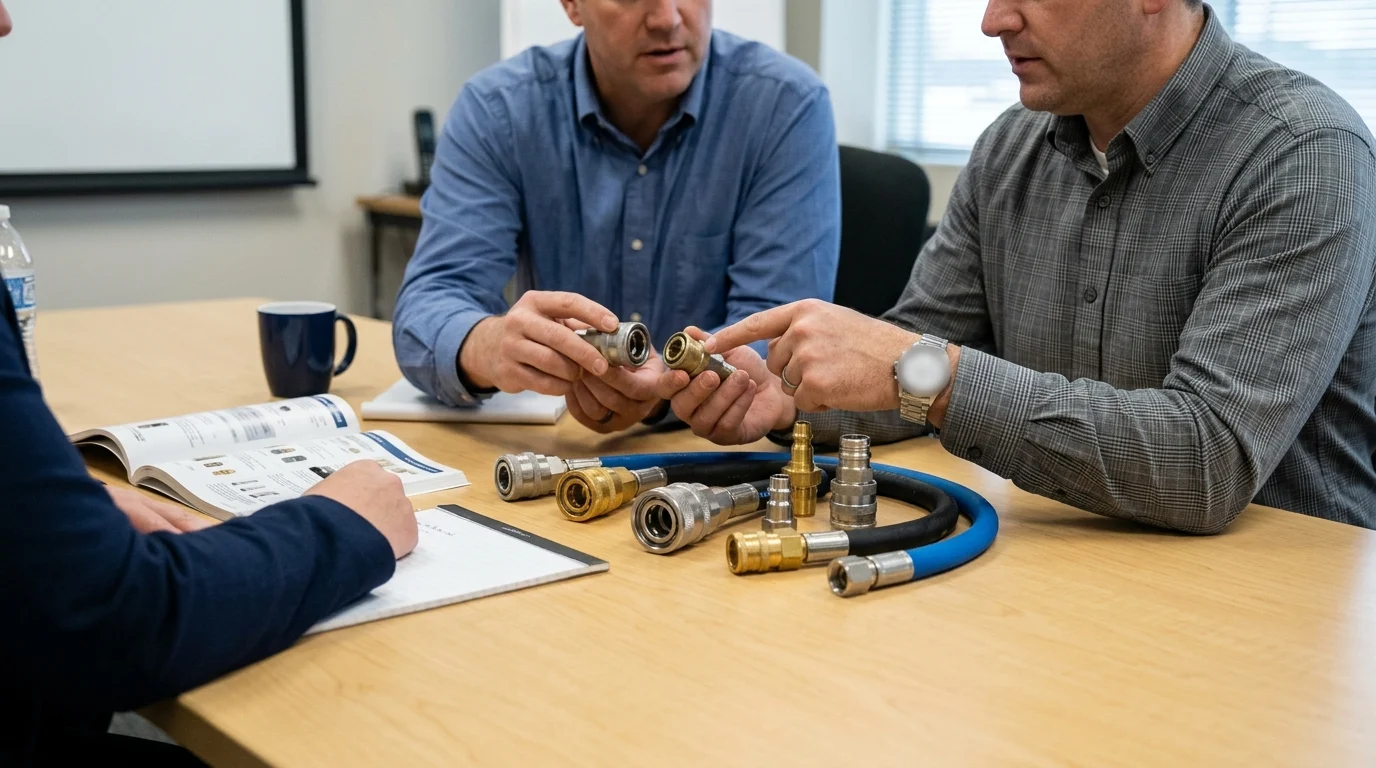
Quick connect hose fittings, also known as quick disconnects (QDs), are specialized couplings designed to join fluid or pneumatic lines rapidly without tools. A complete assembly typically consists of two halves: a plug (male end) and a socket or receptacle (female end). When joined, they create a secure, leak-tight seal capable of handling various media under pressure.
Which design features improve speed, sealing, and ease of use
The internal architecture of a quick connect fitting dictates its operational speed and reliability. Push-to-connect designs allow operators to insert the plug into the socket with a single motion, automatically engaging the locking mechanism. Pull-back sleeve designs require manual retraction of the outer collar, offering a tactile confirmation of a secure lock. Advanced flush-face designs minimize air inclusion during connection and virtually eliminate fluid spillage upon disconnection, a critical feature for hydraulic and hazardous chemical applications.
Sealing integrity is achieved through precision-machined O-rings and backup rings. Depending on the application, these seals utilize elastomers such as FKM, EPDM, or NBR to accommodate different fluids and temperature ranges. Built-in shut-off valves—available in single or double shut-off configurations—automatically close the fluid path when the coupling is separated, preventing system drainage and pressure loss.
What trade-offs matter when comparing quick connect and traditional fittings
Selecting between quick connect and traditional fittings requires balancing upfront investment against long-term operational efficiency. While quick connects excel in speed and usability, they introduce internal valving that can create minor flow restrictions.
| Attribute | Quick Connect Fittings | Traditional Threaded Fittings |
|---|---|---|
| Connection Time | < 10 seconds | 2 to 5 minutes |
| Tooling Required | None (hand-operated) | Wrenches, thread tape/sealant |
| Initial Component Cost | High (typically 3x to 5x higher) | Low |
| Flow Restriction | Moderate (valved designs cause 0.5–2.0 PSI drop) | Minimal (full bore flow) |
| Spill Prevention | Excellent (double shut-off / flush face) | Poor (system must be drained) |
The primary trade-off lies in the initial capital expenditure versus the total cost of ownership. The internal complexity of quick connects also necessitates stricter maintenance of system fluid cleanliness, as particulate contamination can foul the locking balls or internal valve springs, whereas traditional threaded fittings are generally more tolerant of debris.
How do quick connect hose fittings affect performance and cost
The operational success of any fluid handling system depends on matching the fitting’s physical properties to the demands of the environment. Quick connect hose fittings are engineered to strict tolerances, and their performance is inextricably linked to the materials used in their construction and the operational thresholds they are designed to withstand.
How do materials, pressure ratings, temperature limits, and media compatibility affect performance
Material selection is the foundational variable in fitting performance. Brass and aluminum offer cost-effective solutions for standard pneumatic and low-pressure water lines, while 316 stainless steel is mandatory for highly corrosive chemical transfers and offshore marine environments. Engineered plastics, such as POM and PVDF, provide excellent chemical resistance and lightweight profiles for medical and laboratory applications.
Pressure and temperature ratings must align with the system’s maximum operating parameters. Heavy-duty hydraulic quick connects can sustain working pressures exceeding 10,000 PSI (689 bar), whereas standard pneumatic variants typically operate within the 150 to 300 PSI range. Temperature limits are largely dictated by the elastomeric seals; standard NBR seals function between -40°C and 120°C, while specialized perfluoroelastomers (FFKM) can extend operational limits up to 250°C in high-heat applications.
Which cost drivers matter most across installation, maintenance, and replacement
When evaluating cost drivers, procurement teams must look beyond the initial purchase price. The upfront cost of a stainless steel, double shut-off quick connect can range from $50 to over $200 per unit, significantly higher than a standard threaded nipple. However, the true economic value is realized through installation and maintenance savings.
In systems requiring weekly or daily changeovers, the labor savings alone can yield a return on investment within the first six months. Maintenance costs are also influenced by the fitting’s lifecycle; high-quality quick connects are designed for thousands of connection cycles. Cost drivers for replacement include the availability of rebuild kits (O-rings and springs) versus the necessity of replacing the entire coupling when wear occurs.
How should buyers specify and source quick connect hose fittings
Sourcing quick connect hose fittings requires a methodical approach to ensure compatibility, safety, and supply chain reliability. A mismatch in specifications can lead to catastrophic leaks, equipment damage, or costly production halts. Buyers must bridge the gap between engineering requirements and vendor capabilities.
What specification steps help match fittings to the application
Industry professionals rely on the STAMPED methodology (Size, Temperature, Application, Material, Pressure, Ends, Delivery) to specify fittings accurately. Sizing is critical; quick connects are available in nominal diameters ranging from 1/8-inch micro-fittings to heavy-duty 2-inch industrial couplers. Buyers must also calculate the required flow coefficient (Cv) to ensure the internal valving of the quick connect does not induce an unacceptable pressure drop within the system.
End connections must also be carefully specified. While the quick connect interface handles the rapid coupling, the back-end of the fitting must integrate seamlessly with existing infrastructure, whether through NPT threads, BSPP, hose barbs, or sanitary Tri-Clamp flanges.
How should procurement teams assess supplier quality and certifications
Supplier qualification is paramount, particularly in regulated industries. Procurement teams should mandate comprehensive documentation, including material test reports (MTRs) and proof of pressure testing. High-tier manufacturers typically maintain defect rates well below 500 parts per million (PPM) through rigorous statistical process control.
Certifications provide an objective measure of component quality and compliance.
| Standard / Certification | Industry Application | Key Requirement Verified |
|---|---|---|
| ISO 16028 | Hydraulics / Construction | Flush-face design, specific dimensional profiles for interchangeability |
| FDA / CFR Title 21 | Food & Beverage / Pharma | Non-toxic materials, safe for direct food contact |
| ISO 9001:2015 | General Manufacturing | Consistent quality management systems at the supplier level |
| RoHS / REACH | Electronics / Global Export | Restriction of hazardous substances in metal alloys and plating |
When should you choose quick connect over traditional fittings
Despite the compelling advantages of quick connect hose fittings, they are not a universal solution for every fluid and gas transfer requirement. Strategic deployment requires system engineers to identify exactly where rapid changeovers provide measurable value and where traditional methods remain superior.
Which applications still favor traditional connectors
Traditional threaded, flanged, or welded connectors are still preferred in permanent installations where disconnection occurs less than once per year. In these static applications, the higher cost and internal complexity of a quick connect offer no return on investment. Furthermore, traditional fittings excel in ultra-high vibration environments or applications experiencing extreme mechanical stress, where a quick connect’s locking collar could theoretically be compromised.
Additionally, highly viscous fluids, such as heavy resins or slurries, are often better suited to traditional full-bore fittings. The internal poppet valves found in many quick disconnects can restrict the flow of thick media or become jammed by high concentrations of suspended particulates.
What phased implementation approach can reduce conversion risk
For facilities transitioning away from traditional connectors, a phased implementation approach minimizes operational disruption and financial risk. Engineering teams should initiate pilot programs targeting high-frequency changeover nodes, such as injection molding cooling lines, pneumatic tool stations, or end-of-line testing rigs.
During the pilot phase, teams can establish baseline metrics, aiming for specific targets like a 15% reduction in setup times or a zero-spill safety record over a 90-day period. Once these benchmarks are achieved and the maintenance staff is properly trained on the new coupling mechanisms, procurement can confidently scale the adoption of quick connect hose fittings across the broader facility.
Key Takeaways
- The most important conclusions and rationale for quick connect hose fittings
- Specs, compliance, and risk checks worth validating before you commit
- Practical next steps and caveats readers can apply immediately
Frequently Asked Questions
Why are quick connect hose fittings replacing threaded connectors?
They cut connection time from minutes to seconds, reduce tool use, and lower leak, spill, and downtime risks in busy industrial systems.
Where are quick connect hose fittings used most often?
They are common in food and beverage CIP lines, data center liquid cooling, chemical processing, pharmaceuticals, and pneumatic production equipment.
Do quick connect hose fittings affect flow performance?
Yes. Valved designs can add a small pressure drop, typically about 0.5–2.0 PSI, so sizing and valve style should match your flow requirements.
How do I choose the right quick connect hose fitting for my application?
Match media, pressure, temperature, seal material, body alloy, and shut-off type. For custom options, check NBFH Metal’s fitting range and technical support.
What maintenance helps quick connect hose fittings last longer?
Keep fluid clean, inspect O-rings regularly, clean locking parts, and replace worn seals early to prevent leaks, sticking, and unplanned downtime.
Post time: Jun-01-2026