
Introduction
In auto fuel line fittings procurement, the biggest losses often come from defects too small to see. Micro-leaks can slip past basic inspection, yet still trigger evaporative emissions failures, warranty claims, production rework, and long-term reliability issues across high-pressure fuel systems. For B2B buyers, that makes price-per-piece an incomplete metric. This article explains why tiny sealing failures carry outsized compliance and cost risks, what technical and supplier factors most often cause them, and how to evaluate fittings with a lifecycle view that protects both manufacturing performance and downstream liability.
Why Micro-Leaks in Auto Fuel Line Fittings Matter
In the highly regulated automotive manufacturing sector, the integrity of auto fuel line fittings is non-negotiable. While catastrophic ruptures immediately capture engineering attention, the more insidious threat to both compliance and profitability lies in micro-leaks. These are minute seepages or vapor escapes—often measuring less than 1.0 cubic centimeter per minute (cc/min)—that can easily bypass standard end-of-line visual inspections.
For procurement professionals, treating fuel line fittings as simple, commoditized hardware is a costly miscalculation. The procurement focus must shift from basic unit cost to total lifecycle reliability, as the financial and operational consequences of micro-leaks ripple throughout the entire supply chain and vehicle lifespan.
How Small Sealing Losses Become Major Risks
Micro-leaks in auto fuel line fittings may not leave a visible puddle on the assembly floor, but they severely compromise vehicle safety and environmental compliance. Modern fuel systems operate under significant stress; standard port fuel injection systems run at 40 to 70 psi, while gasoline direct injection (GDI) and common rail diesel systems can exceed 2,000 psi and 30,000 psi, respectively. Under these pressures, a microscopic imperfection in a fitting can atomize fuel or allow continuous vapor escape.
Regulatory bodies such as the EPA and CARB strictly govern evaporative emissions. Current standards often require onboard diagnostic (OBD) systems to detect leaks equivalent to an orifice size of just 0.02 inches (0.5 mm). When a fuel line fitting fails to maintain a hermetic seal over varying temperature cycles, the resulting micro-leak triggers check-engine lights, fails emissions testing, and exposes the OEM to severe regulatory fines and forced recalls.
Why Buyers Often Underestimate Leak Impact
Procurement teams frequently underestimate the impact of a micro-leak because the initial per-unit savings obscure the downstream financial liabilities. A buyer might successfully negotiate the price of a quick-connect fitting down from $0.45 to $0.38, saving thousands of dollars on a high-volume production run. However, this calculation rarely accounts for the cost of poor quality (COPQ).
When a micro-leak is discovered post-assembly, the rework costs are substantial. If the defect reaches the consumer, a warranty claim involving fuel system diagnostics, labor, and replacement parts easily exceeds $300 per vehicle. Furthermore, systemic micro-leaks traced back to a specific batch of substandard fittings can trigger regional or national safety recalls, causing irreversible brand damage and eroding any initial procurement savings by a factor of hundreds.
Technical and Material Factors That Affect Sealing
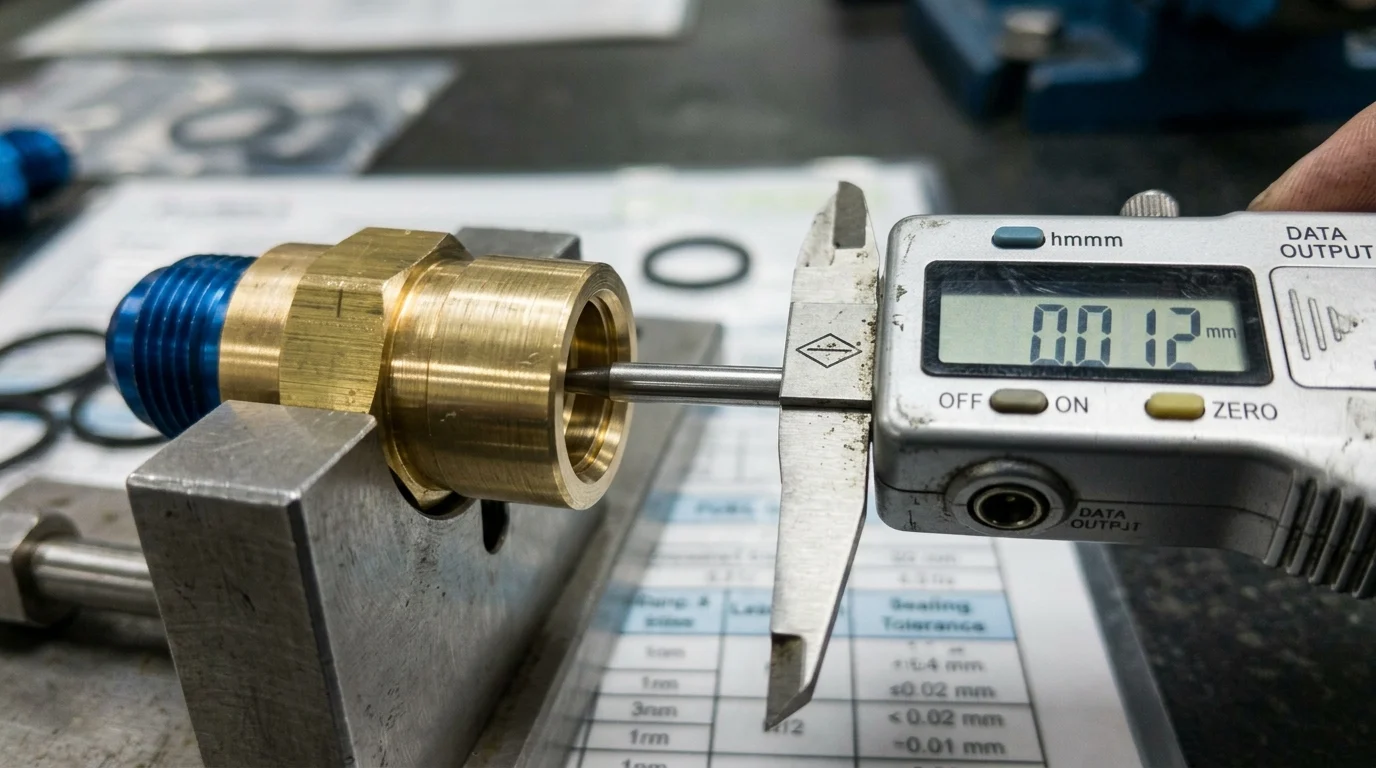
Preventing micro-leaks requires a deep understanding of the engineering and material science behind auto fuel line fittings. Buyers must look beyond basic dimensional drawings to evaluate how suppliers manage the complex interplay of geometry, machining precision, and polymer chemistry under extreme under-hood environments.
How Design Geometry and Tolerance Control Influence Leaks
The primary defense against micro-leaks is the precise geometric relationship between the fitting’s male tube end, the internal O-rings, and the housing. Tolerance stack-up is a critical factor; if the inner diameter of the housing is machined to the maximum allowable tolerance while the O-ring thickness sits at the minimum, the resulting compression ratio may fall below the 15-20% required for a reliable seal.
Surface finish is equally crucial. The sealing surface of a metallic or molded plastic fitting must typically maintain a roughness average (Ra) of less than 0.8 micrometers. Any microscopic scratches, parting line flash, or machining chatter marks create direct leak paths for low-viscosity fuels and vapors, rendering even the highest-quality O-rings ineffective.
Which Material and Coating Choices Matter Most
The choice of materials directly dictates a fitting’s resistance to chemical degradation, thermal expansion, and compression set. Modern fuel blends containing ethanol (E10, E85) or aggressive additives require highly resilient elastomers. While standard Nitrile (NBR) might offer cost advantages, it often degrades when exposed to high temperatures and modern biofuels, leading to embrittlement and micro-leaks.
| Elastomer Type | Base Cost Multiplier | Typical Temp Range | Ethanol/Biofuel Resistance | Primary Use Case |
|---|---|---|---|---|
| NBR (Nitrile) | 1.0x | -40°C to 100°C | Poor to Fair | Low-pressure, non-critical lines |
| HNBR | 2.5x | -40°C to 150°C | Good | Standard automotive fuel lines |
| FKM (Fluorocarbon) | 4.0x | -20°C to 200°C | Excellent | High-heat, aggressive fuel blends |
For the fitting body itself, materials range from glass-filled Nylon 12 for lightweight passenger vehicles to 316L stainless steel for heavy-duty commercial applications. Procurement must verify that the supplier uses virgin resins rather than high percentages of regrind, as regrind plastic introduces internal stresses and micro-voids that compromise structural integrity and leak resistance.
What Specifications Buyers Should Verify
To mitigate sealing risks, buyers must insist on strict adherence to industry-standard specifications. For auto fuel line fittings, SAE J2044 (Quick Connect Coupling Specification for Liquid Fuel and Vapor/Emissions Systems) is the definitive benchmark. Suppliers should provide independent validation that their fittings meet these requirements.
Key metrics within SAE J2044 include a minimum pull-off force (typically greater than 450 N for standard sizes) and stringent leak testing under side-load and vibration conditions. Buyers should also verify specifications regarding burst pressure—which must generally exceed 1,000 kPa for standard low-pressure systems—and ensure that the supplier’s testing protocols cover extreme thermal cycling from -40°C to 115°C.
How to Compare Suppliers Effectively
Differentiating between a world-class automotive supplier and a high-risk vendor requires procurement teams to audit manufacturing processes rigorously. The ability to consistently produce millions of auto fuel line fittings without micro-leaks depends entirely on a supplier’s internal quality management and process control maturity.
Which Criteria Reveal True Supplier Capability
True supplier capability is reflected in their defect rate targets and tooling maintenance protocols. Tier-1 automotive suppliers typically operate with a defect rate of fewer than 5 Parts Per Million (PPM). Achieving this requires automated, closed-loop manufacturing systems rather than reliance on manual operator inspection.
Buyers should investigate the supplier’s preventative maintenance schedule for injection molds and CNC cutting inserts. For example, a supplier that proactively refurbishes O-ring groove tooling every 50,000 cycles demonstrates a commitment to dimensional stability. Conversely, suppliers running tooling to failure will inevitably ship batches with degraded tolerances, resulting in unpredictable micro-leak spikes.
How Leak Testing, Traceability, and Process Control Differ
The methodology a supplier uses to detect leaks before shipment is a major differentiator. Basic water-bath bubble testing or batch sampling is entirely inadequate for detecting micro-leaks in modern fuel systems. Top-tier suppliers implement 100% automated inline testing using pressure decay or helium vacuum methods.
Advanced helium leak testing can detect vapor escapes as minuscule as 1 x 10^-4 mbar L/s, ensuring compliance with strict emissions standards. Furthermore, traceability is essential. The best suppliers utilize laser-etched data matrices or advanced barcode systems to provide lot-level or even piece-level traceability. If a micro-leak issue is identified in the field, this traceability allows the OEM to isolate the suspect batch immediately, preventing a localized manufacturing anomaly from escalating into a full-scale vehicle recall.
Sourcing, Compliance, and Logistics Risks
Procurement risk does not end once the fittings pass final inspection at the supplier’s facility. The journey from the manufacturing plant to the automotive assembly line introduces a host of logistical, environmental, and handling variables that can physically compromise auto fuel line fittings and induce micro-leaks.
How Packaging, Storage, and Handling Affect Leak Performance
O-rings and precision-machined plastic components are highly sensitive to environmental degradation and physical damage. Exposure to direct UV light, ozone from electric motors, or extreme temperature fluctuations during transit can cause premature aging and compression set in elastomeric seals.
Packaging design is a critical procurement consideration. Bulk-shipping fittings in large bins often results in parts colliding, which can scratch sealing surfaces or deform delicate quick-connect retaining clips. Improper bulk packaging has been shown to increase defect rates by 2% to 3% at the point of assembly. Buyers should mandate compartmentalized blister trays, cellular dunnage, or Volatile Corrosion Inhibitor (VCI) packaging for metallic components to ensure the fittings arrive in pristine condition.
Which Compliance and Quality Requirements Buyers Must Check
Compliance in automotive sourcing extends beyond part dimensions to facility-level certifications and material transparency. Buyers must ensure that the supplier holds an active IATF 16949 certification, which mandates continuous improvement, defect prevention, and the reduction of variation in the supply chain.
Additionally, environmental compliance is non-negotiable. Suppliers must provide full material declarations through the International Material Data System (IMDS) to prove compliance with REACH and RoHS directives. Failure to secure these declarations can result in shipments being impounded at customs or production lines being halted due to regulatory violations.
What Supplier Management Steps Reduce Leak-Related Disruptions
To protect the assembly line from leak-related disruptions, procurement teams must implement robust supplier management strategies. Relying on a single source for critical auto fuel line fittings is a high-risk gamble. Implementing a dual-sourcing strategy—such as a 70/30 volume split between a primary and secondary supplier—provides leverage and a vital safety net.
| Logistics Risk Factor | Potential Impact on Fittings | Recommended Mitigation Strategy |
|---|---|---|
| Transit Vibration | Scratched sealing surfaces | Mandate compartmentalized tray packaging |
| Temperature Extremes | O-ring embrittlement/aging | Specify climate-controlled freight for long transits |
| Customs Delays | Line stoppages | Maintain 4-6 weeks of localized buffer stock |
| Single-Source Failure | Complete production halt | Implement 70/30 dual-sourcing strategy |
Furthermore, buyers should negotiate localized inventory agreements. Requiring the supplier or a third-party logistics (3PL) provider to maintain a 4-to-6-week buffer stock near the assembly plant absorbs the shock of transit delays or sudden batch rejections caused by unexpected micro-leak test failures.
How Procurement Teams Can Make Better Trade-Offs
Ultimately, auto fuel line fittings procurement requires balancing upfront unit costs against long-term reliability. Procurement teams must adopt a Total Cost of Ownership (TCO) mindset, recognizing that the cheapest fitting on paper can easily become the most expensive component in the vehicle if it fails to maintain a flawless seal.
What Evaluation Process Balances Cost and Reliability
A robust evaluation process moves beyond the initial Request for Quotation (RFQ) to incorporate the financial risks of quality failures. TCO modeling should explicitly factor in incoming inspection costs, historical scrap rates, and potential warranty reserves.
For instance, evaluating a fitting priced at $0.20 with a historical defect rate of 50 PPM versus a $0.25 fitting with a 2 PPM defect rate requires calculating the true cost of those 48 additional failures. When the labor and diagnostic costs of replacing a leaking fuel line on a finished vehicle are added to the equation, the higher-priced, higher-reliability fitting consistently proves to be the more economical choice.
When a Lower-Priced Option Becomes the Higher-Risk Choice
The danger of aggressive cost-down initiatives becomes apparent when suppliers are forced to cut corners to meet unrealistic price targets. A supplier might substitute a lower-grade elastomer, reduce the frequency of tool maintenance, or switch from 100% inline leak testing to statistical batch sampling.
Consider a scenario where procurement saves 10% on an annual spend of $500,000, yielding a theoretical savings of $50,000. If that lower-priced option introduces a micro-leak issue that triggers a medium-scale recall of just 10,000 vehicles, the resulting costs for parts, labor, and regulatory penalties can easily surpass $2 million. By treating auto fuel line fittings as critical safety components rather than generic hardware, procurement teams can protect their organizations from these disproportionate risks and ensure seamless, leak-free performance.
Key Takeaways
- The most important conclusions and rationale for auto fuel line fittings
- Specs, compliance, and risk checks worth validating before you commit
- Practical next steps and caveats readers can apply immediately
Frequently Asked Questions
What is a micro-leak in auto fuel line fittings?
It is a tiny fuel or vapor escape, often under 1.0 cc/min, that may pass visual inspection but still cause emissions faults, warranty claims, or safety risks.
Why shouldn’t B2B buyers choose fittings by unit price alone?
A small piece-price saving can be erased by rework, failed emissions tests, warranty repairs over $300 per vehicle, or recall exposure from batch-level sealing defects.
Which specifications most affect sealing reliability?
Focus on tolerance control, O-ring compression around 15–20%, sealing surface finish below Ra 0.8 μm, and material compatibility with ethanol blends and under-hood temperatures.
Which O-ring material is better for modern fuel systems?
For ethanol-containing fuels and higher temperatures, FKM usually outperforms standard NBR by resisting swelling, embrittlement, and compression set that can lead to micro-leaks.
How can buyers reduce leak risk when sourcing from nbfh-metal.com?
Request validation data for leak testing, tolerance capability, surface finish, and fuel compatibility, then confirm the fitting matches your pressure, temperature, and fuel-blend requirements.
Post time: Jun-12-2026