
Introduction
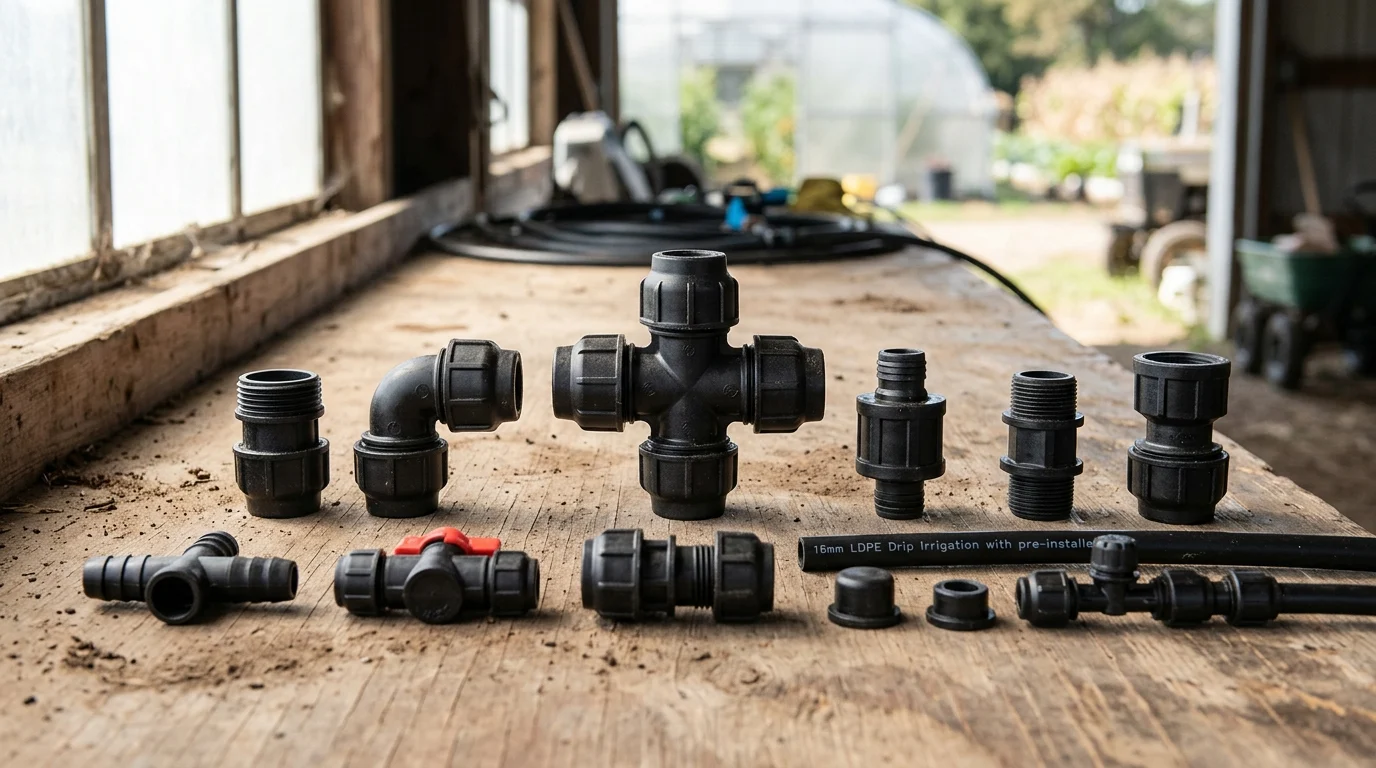
Reliable irrigation depends on more than pipe layout; the connectors, adapters, elbows, tees, valves, and reducers between those lines often determine whether water moves efficiently or is lost to leaks, pressure drops, and premature failures. This article explains the main types of agricultural irrigation fittings, the materials commonly used to make them, and how each option fits different field conditions, pressures, and irrigation methods. By the end, readers will be better prepared to compare durability, compatibility, and cost so they can choose fittings that support uniform water delivery, easier maintenance, and longer system life.
Why Agricultural Irrigation Fittings Matter
Agricultural irrigation networks rely on precise hydraulic engineering to distribute water efficiently across large acreages. At the core of these networks are irrigation fittings—the critical junctions that connect pipes, navigate topography, and regulate flow distribution. While pipes form the arteries of the system, fittings determine the structural integrity and operational reliability of the entire network.
The selection of these components directly influences the total cost of ownership for agricultural operations. Because a system is only as robust as its weakest connection, specifying high-quality fittings is a non-negotiable aspect of irrigation design.
Impact on Flow Integrity
Hydraulic efficiency depends heavily on minimizing friction and turbulence as water navigates through a system. Every change in direction or pipe diameter introduces a friction loss coefficient (k-value). Inferior or poorly sized fittings create significant pressure drops, forcing irrigation pumps to work harder to maintain uniform coverage.
Operating pumps against unnecessary backpressure can increase energy consumption by up to 15%. Furthermore, maintaining laminar flow through smooth-walled, properly matched fittings ensures that downstream emitters—such as drip lines or micro-sprinklers—receive the exact operating pressure required for optimal water distribution.
Risks of Poor Fitting Selection
Substandard fitting selection exposes agricultural operations to immediate and long-term liabilities. Material fatigue, improper pressure ratings, or incompatible thread types inevitably lead to system failures, ranging from slow leaks to catastrophic blowouts during peak irrigation cycles.
The quantitative impact of a seemingly minor failure is substantial: a single 3mm (1/8-inch) leak in a system operating at 40 PSI can waste over 1,500 gallons of water per month. Beyond the direct costs of water and pumping energy, localized flooding from blown fittings can cause severe soil erosion, nutrient leaching, and significant crop yield reductions in the affected zones.
Types of Agricultural Irrigation Fittings
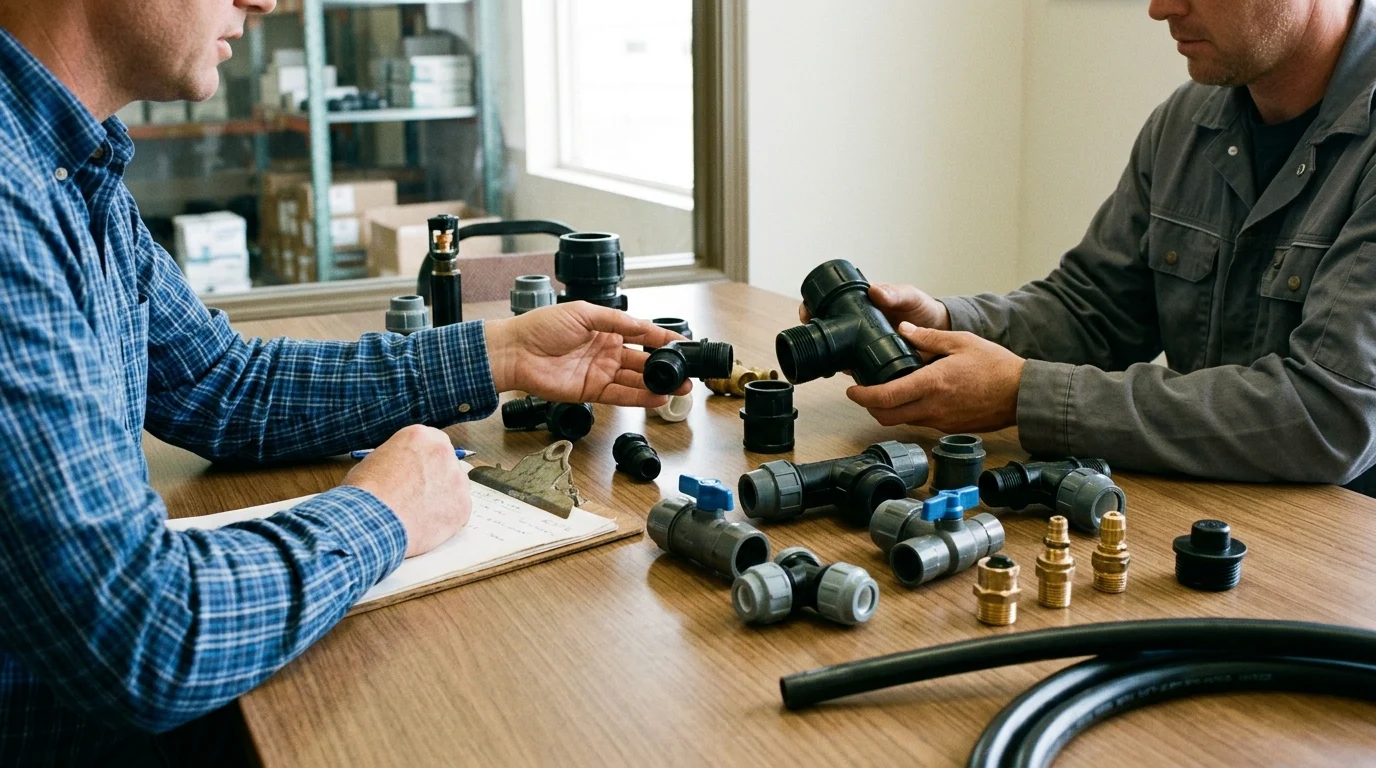
Modern agricultural irrigation utilizes a diverse array of fitting types, each engineered to address specific connection requirements, pipe materials, and pressure parameters. Understanding the geometric and mechanical variations among these components is essential for designing scalable, serviceable water delivery systems.
Common Fitting Categories
The fundamental geometries of irrigation fittings include tees, elbows, couplings (or splicers), reducers, and end caps. Tees and elbows are utilized to branch lines and navigate corners, respectively, while couplings join two pipes of the same diameter. Reducers are critical for stepping down pipe sizes from high-capacity mainlines to lower-capacity lateral lines, ensuring proper velocity and pressure transitions.
Mechanically, these fittings secure to pipes via several distinct methods: barbed insert fittings for flexible tubing, compression fittings that utilize a locking nut and O-ring seal for rigid or semi-rigid pipes, and threaded fittings (NPT or BSPT) for high-pressure rigid connections.
Key Comparison Points
Selecting the correct connection mechanism requires balancing installation efficiency against mechanical strength and system pressure demands.
| Connection Type | Typical Max Pressure (PSI) | Installation Speed | Reusability | Ideal Pipe Material |
|---|---|---|---|---|
| Barbed Insert | 30 – 50 | Very Fast | Low | LDPE / Drip Tape |
| Compression | 150 – 230 | Moderate | High | HDPE / MDPE |
| Threaded | 100 – 300+ | Slow | Moderate | PVC / Metal |
| Solvent Weld | 150 – 300 | Moderate | None | Rigid PVC |
This comparative data highlights why compression fittings are favored for modular, high-pressure field systems, whereas barbed fittings dominate low-pressure drip applications.
Typical Uses in Irrigation Systems
Within a standard agricultural layout, fitting applications vary drastically by zone. Mainlines, which often utilize 2-inch to 6-inch PVC or HDPE pipes, require heavy-duty solvent-welded or flanged fittings capable of withstanding constant pump pressure and water hammer effects.
Conversely, lateral lines and sub-mains deploying 16mm or 20mm polyethylene tubing rely predominantly on barbed or specialized tape-loc fittings. These micro-irrigation fittings are designed for rapid deployment across hundreds of acres, allowing farm technicians to quickly assemble, flush, and repair drip tape networks at the start of each growing season.
Best Materials for Agricultural Irrigation Fittings
The physical composition of an irrigation fitting dictates its resistance to environmental stressors, agricultural chemicals, and mechanical strain. Specifying the correct material is as critical as selecting the appropriate fitting geometry, as material degradation is a leading cause of premature system failure.
Common Material Options
The agricultural sector predominantly utilizes engineered plastics due to their corrosion resistance and cost-effectiveness. Polyvinyl Chloride (PVC) is the standard for rigid, high-pressure mainline connections. Polyethylene (PE) and Polypropylene (PP) are widely used for compression and barbed fittings due to their flexibility and impact resistance.
In scenarios requiring extreme durability—such as pump station manifolds, high-vibration zones, or fertigation injection points—metallic fittings (specifically brass, stainless steel, or galvanized iron) are deployed to handle mechanical stresses that would fracture plastic alternatives.
Material Trade-Offs
Each material presents specific engineering trade-offs regarding thermal stability, chemical resistance, and capital expenditure.
| Material | Max Operating Temp (°C) | UV Resistance | Chemical (Fertilizer) Resistance | Relative Cost Index |
|---|---|---|---|---|
| PVC (Schedule 40/80) | 60 | Low (Requires coating) | High | $ |
| Polypropylene (PP) | 80 | High (Carbon black added) | Very High | $$ |
| Polyethylene (PE) | 60 | High (Carbon black added) | Very High | $$ |
| Brass | 90+ | Excellent | Moderate (Corrodes at low pH) | $$$$ |
While brass offers superior burst strength, its susceptibility to corrosion from acidic fertilizers (pH below 5.5) often makes premium UV-stabilized PP or PE a more reliable choice for modern fertigation networks.
Compatibility and Service Life
Material compatibility between the pipe and the fitting is paramount to long-term service life. Dissimilar materials have different coefficients of thermal expansion; for instance, PE expands at roughly 0.12 mm/m/°C. Coupling a rigid metal fitting directly to a long run of exposed PE pipe without a flexible transition can result in stress fractures during severe temperature fluctuations.
When correctly matched and protected from extreme environmental abuse, UV-stabilized plastic fittings routinely achieve a service life of 15 to 20 years in agricultural environments, ensuring the capital investment yields reliable returns over multiple crop cycles.
How to Specify, Source, and Install Fittings
Translating an irrigation design into a functional field system requires rigorous procurement standards and disciplined installation practices. Overlooking specification details or accepting poor manufacturing tolerances during the sourcing phase will inevitably compound into severe operational defects during deployment.
Critical Specification Checks
Engineers must verify several critical specifications before authorizing procurement. Pressure ratings must align with the system’s maximum dynamic head; for example, specifying PN10 (10 bar / 145 PSI) or PN16 (16 bar / 232 PSI) fittings depending on mainline stress.
Additionally, thread compatibility is a frequent point of failure in international sourcing. Mismatches between National Pipe Thread (NPT) and British Standard Pipe Taper (BSPT) will result in compromised seals. Buyers must also strictly differentiate between Nominal Diameter (DN) and exact Outside Diameter (OD) metrics to ensure compression rings and solvent sockets mate flawlessly with the selected piping.
Sourcing and Quality Factors
Sourcing agricultural fittings at scale requires vetting manufacturers for adherence to international quality standards, such as ISO 14236 for plastics pipes and fittings or ISO 9001 for quality management systems. Certifications guarantee that the polymer blends are consistent and free from excessive regrind material, which can cause brittleness.
From a logistics standpoint, commercial agricultural projects require bulk procurement. Buyers must navigate Minimum Order Quantities (MOQs), which typically range from 1,000 to 5,000 units for smaller 16mm to 32mm lateral fittings, while larger 4-inch to 8-inch mainline fittings may be sourced in much smaller batches. Factoring in lead times of 4 to 8 weeks for bulk international freight is essential for meeting seasonal planting deadlines.
Installation and Inspection Basics
Proper installation protocols safeguard the structural integrity of the fittings. For threaded connections, technicians should apply 2 to 3 wraps of high-density PTFE (Teflon) tape to prevent galling and ensure a watertight seal, avoiding over-tightening, which can crack plastic female threads. Rigid PVC connections require meticulous deburring and the correct application of primer and solvent cement.
Before backfilling any trenched lines, the entire network must undergo a hydrostatic pressure test. Standard practice dictates pressurizing the system to 1.5 times its maximum intended operating pressure for at least one hour to identify and rectify weak joints or defective fittings before they are buried.
How to Choose Fittings for Different Applications
No single fitting type or material serves every agricultural scenario. System designers must deploy a structured selection framework that evaluates the unique hydraulic, environmental, and economic parameters of the specific farming operation to determine the optimal fitting strategy.
Selection Framework
The primary selection framework begins with hydraulic demand: calculating the maximum flow rate (GPM or L/h) and operating pressure required by the crop layout. High-pressure center pivot or solid-set sprinkler systems necessitate robust mechanical connections, heavily favoring flanged metal or heavy-wall PVC fittings.
Water quality also dictates fitting selection. Irrigation sources drawing from surface water or municipal effluent often contain high loads of suspended abrasive particulates. In these cases, fittings with smooth internal transition zones and high abrasion resistance are required to prevent internal scouring over time.
Environmental and Operating Factors
Environmental exposure aggressively degrades irrigation infrastructure. In regions subject to hard freezes, rigid mainline fittings must be buried safely below the frost line—typically deeper than 60 cm (24 inches)—and designed with adequate drainage valves to prevent ice expansion fractures.
Surface-level fittings face different threats. Intense solar radiation requires carbon-black compounded plastics to prevent UV embrittlement. Furthermore, systems utilized for aggressive fertigation—where injected chemical solutions can drive water pH down to 4.0 or up to 8.0—mandate the use of chemically inert Polypropylene or Polyethylene fittings over standard brass or galvanized components.
Long-Term Value Considerations
Evaluating fittings solely on initial capital expenditure is a flawed procurement strategy. A comprehensive Total Cost of Ownership (TCO) model must account for replacement labor, system downtime, and potential crop loss due to water stress.
Opting for higher-rated components, such as utilizing PN16 compression fittings over cheaper PN6 alternatives in high-stress sub-mains, requires a higher initial investment. However, field data indicates this strategic upgrade can reduce 10-year maintenance and replacement costs by 30% to 40%, ultimately delivering superior long-term value to the agricultural enterprise.
Key Takeaways
- The most important conclusions and rationale for Agricultural Irrigation Fittings
- Specs, compliance, and risk checks worth validating before you commit
- Practical next steps and caveats readers can apply immediately
Frequently Asked Questions
Which irrigation fitting type is best for drip lines?
Barbed insert fittings are usually best for LDPE tubing and drip tape at about 30–50 PSI. They install fast and work well for seasonal lateral lines and quick field repairs.
When should I choose compression fittings for irrigation systems?
Use compression fittings for HDPE or MDPE lines when you need stronger, reusable connections, typically up to about 150–230 PSI. They suit sub-mains and modular field systems.
Why do fitting materials matter in agricultural irrigation?
Material affects pressure resistance, chemical compatibility, UV durability, and leak risk. Choose fittings matched to your pipe, water quality, and fertilizer use to reduce failures and maintenance.
How can I reduce pressure loss in an irrigation network?
Use correctly sized, smooth, well-matched fittings and avoid unnecessary elbows or reducers. This helps maintain stable downstream pressure and can lower pump energy use.
Where can I source metal or precision irrigation fittings for agricultural systems?
You can review fitting options on nbfh-metal.com, including compression and push fitting solutions. Check thread type, pressure rating, and pipe compatibility before ordering for farm use.
Post time: May-25-2026